



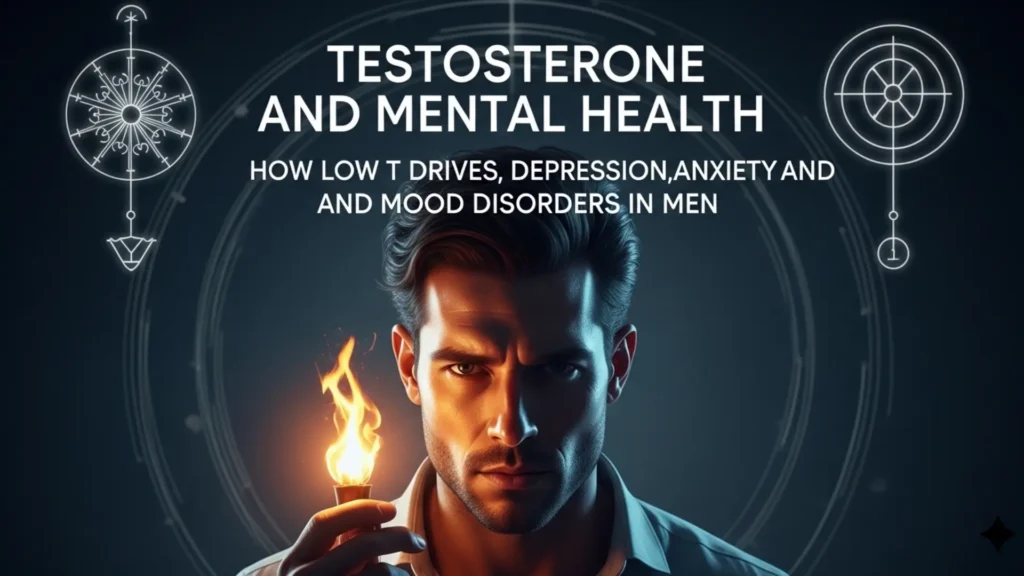

Among all the consequences of testosterone deficiency, the psychological ones are perhaps the most devastating — and the most frequently misdiagnosed. At Vitalis Luxe Clinic, we regularly see men who have been experiencing depression, anxiety, emotional flatness, and loss of motivation for months or years — men who have been prescribed antidepressants, sometimes multiple times, without meaningful improvement. In many of these cases, the underlying driver is not a primary psychiatric condition. It is clinically low testosterone.
This is not a niche or fringe observation. The relationship between testosterone and brain function is well-established in the clinical and neuroscientific literature. Testosterone receptors are present throughout the central nervous system. Testosterone directly influences dopaminergic and serotonergic signalling — the same neurotransmitter systems that antidepressants target. And testosterone deficiency produces biologically mediated mood disorders that simply do not respond to antidepressants in the way that primary depression does.
In this article, we explore the mechanisms behind this relationship, describe the distinctive psychological presentation of testosterone deficiency, explain why it is so often misdiagnosed, and clarify what men can realistically expect from TRT in terms of mental health improvement — and where TRT’s limitations lie.
Table of Contents
How Testosterone Affects the Brain: The Neuroscientific Basis

Testosterone is not merely a hormone of physical masculinity. It is a neuroactive steroid with direct, well-characterised effects on central nervous system function. Understanding these effects explains why deficiency produces such profound psychological consequences.
Learn more about Testosterone and Diabetes.
Dopaminergic System: Motivation, Reward, and Drive

Testosterone modulates the dopaminergic system — the brain’s primary reward and motivation pathway. Dopamine drives goal-directed behaviour, the anticipation of reward, and the sense of agency and purpose in daily life. Testosterone enhances dopamine receptor sensitivity and dopamine release in key brain regions including the nucleus accumbens and prefrontal cortex.
When testosterone falls, dopaminergic tone is reduced. The practical consequence: men lose the wanting that makes life feel meaningful and purposeful. Activities that previously produced engagement and satisfaction produce nothing. Goals feel pointless. Effort seems unrewarded. This is not laziness or weakness — it is a neurochemical shift driven by hormonal deficiency. And it does not respond to cognitive reframing or willpower, because it is biological in origin.
Serotonergic System: Mood, Resilience, and Emotional Regulation

Testosterone also interacts with serotonergic signalling — the system most directly targeted by SSRIs (selective serotonin reuptake inhibitors) and other antidepressants. Testosterone influences the expression of serotonin receptors and the activity of serotonin-synthesising enzymes. Low testosterone is associated with reduced serotonergic tone, contributing to the low mood, emotional vulnerability, and impaired stress resilience characteristic of deficiency.
This serotonergic interaction is one reason why antidepressants often underperform in men with testosterone deficiency-related depression. If the underlying cause of reduced serotonergic tone is hormonal deficiency rather than primary serotonergic dysfunction, targeting serotonin reuptake without addressing the hormonal deficit produces a partial and often frustratingly incomplete response.
GABA and Anxiety

Testosterone and its neuroactive metabolites — particularly allopregnanolone, derived via progesterone conversion — act as positive modulators of GABA-A receptors, producing anxiolytic (anti-anxiety) effects. Low testosterone reduces the availability of these neuroactive steroids, increasing neuronal excitability and contributing to the anxiety, irritability, and emotional reactivity that many men with deficiency experience.
This GABAergic mechanism helps explain why men with testosterone deficiency often describe feeling ‘on edge,’ easily stressed, or unable to tolerate situations they previously handled calmly. It is not a change in their character. It is a change in their neurochemistry.
Cortisol Antagonism: Stress Buffering

Testosterone has a direct antagonistic relationship with cortisol at multiple levels of the stress response axis. Adequate testosterone buffers the cortisol stress response, allowing the system to return to baseline more rapidly after a stressor. Low testosterone removes this buffering, leaving men more vulnerable to sustained cortisol elevation, which itself directly suppresses testosterone further — another self-reinforcing cycle.
The Psychological Presentation of Testosterone Deficiency
The psychological profile of testosterone deficiency is distinctive enough that it can often be differentiated from primary depression or anxiety by a careful clinical history — though it is not always cleanly separable, and comorbidity is common.
| Psychological Feature | How It Presents in Low T Men | How It Differs from Primary Depression |
|---|---|---|
| Emotional flatness / anhedonia | Loss of interest and pleasure is present, but often described as ‘numbness’ or ‘not caring’ rather than active sadness; a reduced emotional range rather than sustained negative affect | Primary depression often features more active sadness, hopelessness, and negative ideation; low T anhedonia has a more ‘flat’ quality |
| Loss of motivation and drive | Profound reduction in goal-directed behaviour; loss of ambition, career engagement, and personal projects; ‘nothing feels worth doing’ | Motivation loss in primary depression is often accompanied by guilt and self-criticism; low T motivation loss is often described as simply ‘not caring’ without the guilt overlay |
| Irritability and low frustration tolerance | Easy irritability, disproportionate frustration, reduced patience — often more prominent than sadness; sometimes the presenting complaint is anger rather than low mood | Irritability is present in depression but the predominance of irritability over sadness, with preserved insight, is a pattern common in hormonal mood disorders |
| Anxiety and on-edge feeling | Generalised sense of being easily stressed, unable to relax, hypervigilant; not always accompanied by identifiable triggers | Low T anxiety tends to be more generalised and physiological than cognitive; less ruminative than anxiety disorder |
| Brain fog and cognitive slowing | Difficulty concentrating, poor short-term memory, mental slowness that is experienced as distinctly different from the person’s normal baseline | Cognitive symptoms in primary depression are common but typically improve with mood; in low T, cognitive changes can be prominent even when mood is only mildly affected |
| Loss of sense of self | Men frequently describe feeling ‘not like myself’, ‘a shadow of who I was’, or ‘going through the motions’; this identity-level disruption is particularly characteristic | This quality of disconnection from one’s previous self is particularly prominent in testosterone deficiency and often the most distressing aspect for patients |
The Misdiagnosis Problem: Why Low T Is Mistaken for Depression

The overlap between the psychological presentation of testosterone deficiency and clinical depression is extensive — and the systematic failure to assess testosterone in men presenting with depressive symptoms is one of the most significant gaps in men’s healthcare in the UK.
The typical pathway for a man with testosterone deficiency presenting to his GP with mood complaints: he is assessed with a depression questionnaire (PHQ-9 or similar), scores in the moderate-to-severe range, and is prescribed an SSRI. His testosterone is not measured. He tries the antidepressant for several months and notices partial or minimal improvement. A second antidepressant is tried. The cycle continues. The hormonal cause remains unidentified and untreated.
This is not an uncommon clinical scenario. It is a frequent one. And it represents a significant harm — not because antidepressants are wrong in themselves, but because they are addressing the wrong target. You cannot correct a testosterone deficiency with a serotonin reuptake inhibitor.
Several clinical features should prompt testosterone assessment in any man presenting with depressive or anxiety symptoms:
- Male sex — testosterone is the primary sex hormone whose deficiency most directly affects mood in men
- Age 30 or above — the period of potential testosterone decline begins in the thirties for many men
- Concurrent physical symptoms of testosterone deficiency — fatigue, reduced libido, reduced morning erections, difficulty building muscle, body composition changes
- Inadequate response to antidepressant treatment — partial or non-response to one or more antidepressant trials
- Onset of mood change preceded by or concurrent with onset of physical symptoms
- Patient reporting symptoms that feel distinctly different from their previous depressive episodes (if any)
| A Message to Men Prescribed AntidepressantsIf you are currently on antidepressants and your mood has not improved significantly — particularly if you are also experiencing fatigue, reduced libido, and the other physical symptoms described in this article — please ask for a testosterone blood test. You may be receiving treatment for the wrong condition. This does not mean antidepressants are always wrong; they may be a valid component of your treatment even if hormonal deficiency is also present. But the hormonal piece cannot be treated if it has never been identified. |
What TRT Does for Mental Health: Evidence and Realistic Expectations
The Evidence Base
Multiple clinical studies and systematic reviews have examined the effects of testosterone replacement therapy on mood in men with confirmed deficiency. The consistent findings are:
- TRT significantly reduces depressive symptom scores in hypogonadal men with depression — meta-analyses find effect sizes comparable to antidepressant treatment
- TRT improves subjective wellbeing, energy, motivation, and sense of vitality in men with confirmed deficiency
- TRT improves anxiety symptoms and stress resilience in men with testosterone deficiency
- The mood response to TRT in hypogonadal men is substantially better than in eugonadal men (those with normal testosterone) — again underscoring that the benefit is specific to those with genuine deficiency
- Combination of TRT and antidepressants may outperform either alone in men who have both hormonal deficiency and primary depression components
Typical Timeline for Mood Improvement on TRT
| Psychological Outcome | Typical Onset | Time to Full Benefit |
|---|---|---|
| Initial lift in energy and motivation | 2–4 weeks | 4–8 weeks |
| Reduced emotional flatness / anhedonia returning | 3–6 weeks | 6–12 weeks |
| Improved stress resilience and reduced irritability | 3–6 weeks | 6–12 weeks |
| Reduced anxiety / on-edge feeling | 3–8 weeks | 8–16 weeks |
| Full mood restoration — return to sense of self | 2–4 months | 3–6 months |
| Cognitive clarity — concentration, mental sharpness | 4–8 weeks | 3–6 months |
| Sustained, stable psychological wellbeing | 3–6 months | 6–12 months |
Where TRT Has Limitations for Mental Health
TRT is not a universal antidepressant. Its psychological benefits are specific to men with confirmed testosterone deficiency — men in the normal testosterone range who are experiencing depression will not typically benefit from testosterone supplementation, and administering testosterone to eugonadal men is neither appropriate nor effective for mood disorders.
TRT also does not resolve depression arising from psychological causes — grief, trauma, relationship breakdown, occupational stress, or other life circumstances that produce genuine depressive illness independently of hormonal status. In these situations, the appropriate treatment includes psychological support (talking therapies, CBT, counselling) and possibly antidepressants — with TRT as a complementary treatment if deficiency is also present, but not as a standalone solution.
Additionally, some men find that physical symptoms (libido, energy) improve on TRT more rapidly and completely than psychological ones. Full psychological restoration sometimes takes longer and may benefit from psychological support alongside hormonal treatment — particularly for men who have been depressed for a prolonged period before their hormonal deficiency was identified.
The Question Men Often Don’t Ask: Am I Anxious or Hormonally Deficient?
Anxiety in men with testosterone deficiency presents differently from classical anxiety disorders — and this difference is clinically important. Men with hormonal anxiety often describe a physiological on-edge feeling — heightened reactivity to stressors, difficulty returning to calm after minor provocations, an inability to relax that is experienced in the body as much as in the mind.
This contrasts with the ruminative, cognitive pattern of generalised anxiety disorder, where worry is the primary experience. Men with testosterone deficiency-related anxiety often have good insight — they recognise that their reactions are disproportionate, that they are more easily stressed than they used to be, and that the change has accompanied other physical changes rather than arising from specific psychological triggers.
When a man describes anxiety that came on gradually alongside fatigue, reduced libido, and body composition changes — rather than developing in the context of specific life stressors — a testosterone blood test is an important part of the clinical picture, not an afterthought.
Mental Health, Masculinity, and the Barrier to Seeking Help
It would be incomplete to discuss testosterone and men’s mental health without acknowledging the cultural dimension. Many men experiencing depression, anxiety, and psychological distress in the context of testosterone deficiency do not seek help — not primarily because they don’t know where to go, but because the cultural narrative around masculinity makes it difficult to identify oneself as someone who is struggling psychologically.
The framing of testosterone deficiency as a physical, medical condition — rather than primarily a mental health issue — sometimes makes it easier for men to engage with the clinical conversation. ‘There is something physically wrong with my hormones’ is easier to accept than ‘I am depressed.’ Both can be true simultaneously, and neither diminishes the other.
At Vitalis Luxe Clinic in Hull, we approach this with sensitivity. We do not require men to label themselves in ways that feel uncomfortable. We take a thorough history, measure what needs measuring, and let the clinical evidence guide the conversation — giving men the facts they need to understand what is happening and to make an informed decision about treatment.
Frequently Asked Questions
Can low testosterone cause depression?
Yes — testosterone deficiency can cause biologically mediated depression through its effects on dopaminergic, serotonergic, and GABAergic neurotransmitter systems. This is not simply ‘feeling down because you’re unwell’ — it is a neurochemical change produced by hormonal deficiency that produces genuine depressive illness. Men with testosterone deficiency-related depression typically respond poorly to antidepressants alone, because the hormonal driver of their symptoms is not being addressed.
Does TRT help with depression?
For men with confirmed testosterone deficiency and depressive symptoms, TRT consistently reduces depression scores in clinical studies — with effect sizes comparable to antidepressant treatment. The benefit is specific to men with genuine deficiency; TRT does not treat depression in eugonadal men. TRT may be used alongside antidepressants in men who have both hormonal deficiency and a primary depressive component. Mood improvements typically begin within three to six weeks and continue building over three to six months.
Why is my antidepressant not working?
If you are male, experiencing significant fatigue, reduced libido, and other physical symptoms alongside your mood disorder, and your antidepressant is not producing the expected improvement, testosterone deficiency may be a contributing or primary cause. A testosterone blood test is a simple and appropriate next step. Many men in this situation have never had their testosterone measured despite years of antidepressant treatment.
Can testosterone deficiency cause anxiety?
Yes. Testosterone and its neuroactive metabolites (including allopregnanolone) modulate GABA-A receptors, producing anxiolytic effects. Low testosterone reduces this anxiolytic tone, increasing neuronal excitability and contributing to generalised anxiety, irritability, and emotional reactivity. The anxiety associated with testosterone deficiency tends to be more physiological and reactivity-based than the ruminative, cognitive anxiety of generalised anxiety disorder — though both can coexist.
How long does TRT take to improve mood?
Initial improvements — a lift in energy, early reduction in emotional flatness, reduced irritability — are often noticeable within two to four weeks. More substantial mood improvement typically develops over six to twelve weeks. Full psychological restoration — the return of drive, resilience, sense of self, and sustained wellbeing — often takes three to six months. For men with severe or long-standing deficiency, meaningful improvement continues building into the first year.
Should I stop my antidepressants if I start TRT?
Do not stop antidepressants without discussing it with your prescribing doctor. TRT and antidepressants can be used together and may complement each other in men who have both hormonal deficiency and a primary psychiatric component. As mood improves on TRT, a planned, gradual reduction in antidepressants may be appropriate over time — but this is a supervised clinical decision, not something to do unilaterally.
I’ve been told my testosterone is ‘normal’ but I’m still depressed — could it still be hormonal?
Possibly. ‘Normal’ on a standard GP blood test does not always mean optimal for the individual. If your total testosterone is in the low-normal range (12–15 nmol/L), your free testosterone may be subtherapeutic due to elevated SHBG. If your test was taken in the afternoon (testosterone is 20–35% lower than morning levels), the result may underestimate your true status. A comprehensive assessment — morning total testosterone, free testosterone, SHBG, LH, FSH — gives a far more complete picture.
Where can I get testosterone and mental health assessed together in Hull or Yorkshire?
Vitalis Luxe Clinic in Hull provides comprehensive hormone assessments that include a detailed psychological history as standard — because we recognise that mood, motivation, and mental wellbeing are core components of men’s hormonal health, not separate concerns. We serve men across Hull, East Yorkshire, and throughout Yorkshire, with in-person and online consultations available.