




There is a conversation that happens in GP surgeries across Yorkshire with depressing regularity. A man in his mid-fifties presents with fatigue, reduced libido, mood changes, difficulty maintaining his physique, and sleep that no longer refreshes him. He has been feeling this way for two or three years — perhaps longer. His doctor checks his testosterone, finds it at 9 or 10 nmol/L, and tells him this is normal for his age. He goes home no better informed and no closer to a solution.
At Vitalis Luxe Clinic , we see this man regularly. And what he deserves — what he has often not received — is a clear, clinical explanation of the difference between testosterone and Ageing decline that falls within the spectrum of normal ageing and testosterone deficiency that is treatable and that is causing his symptoms. These are not the same thing, and conflating them by saying ‘it’s your age’ when what is actually happening is clinically significant hypogonadism is a disservice to him.
This article explains what late-onset hypogonadism is, how it differs from the normal ageing process, what the evidence shows about treating it, and what older men genuinely need to know before deciding whether clinical assessment is the right step.
Table of Contents
The Ageing Testosterone Trajectory

Testosterone decline with age is a genuine biological phenomenon — not a myth. From the mid-30s, testosterone falls at approximately 1–2% per year in most men, with both the rate and the absolute level varying substantially between individuals depending on genetics, lifestyle, metabolic health, and the presence of comorbid conditions.
Alongside the absolute fall in testosterone, sex hormone-binding globulin (SHBG) rises with age — progressively binding a greater proportion of total testosterone and reducing the biologically active free fraction. The result: free testosterone falls faster than total testosterone with age. A 60-year-old man with a total testosterone of 12 nmol/L may have a free testosterone equivalent to someone ten years younger with 9 nmol/L — the SHBG effect compounds the absolute decline.
Age Decade | Typical Total Testosterone Range | Typical Free Testosterone Trend | Population Context |
|---|---|---|---|
20s | 15–35 nmol/L | High-normal; SHBG relatively low | Peak production years; most men well above any clinical threshold |
30s | 13–30 nmol/L | Beginning gradual decline | Decline begins; rarely clinically symptomatic from T alone at this stage |
40s | 11–25 nmol/L | More perceptible free T decline as SHBG begins rising | Subset of men enter symptomatic low-normal range, particularly if lifestyle factors compound decline |
50s | 10–22 nmol/L | Free T declining faster than total | Increasing prevalence of symptomatic deficiency; late-onset hypogonadism most commonly diagnosed in this decade |
60s | 8–20 nmol/L | SHBG elevation substantial; free T often significantly lower than total T suggests | Significant proportion clinically symptomatic; total T ‘in range’ but free T deficient not uncommon |
70s+ | 6–17 nmol/L | Free T often severely reduced relative to young-adult reference | Majority of men have meaningful testosterone reduction; clinical deficiency common and frequently undertreated |
What Is Late-Onset Hypogonadism?

Late-onset hypogonadism (LOH) — sometimes called age-related hypogonadism, androgen deficiency of the ageing male (ADAM), or (less precisely) ‘andropause’ or ‘male menopause’ — is defined as a clinical syndrome combining biochemical testosterone deficiency with specific symptoms attributable to that deficiency in men who do not have a primary testicular or pituitary pathology.
The critical distinction from the normal ageing process is not simply that testosterone has fallen — testosterone falls in all men with age — but that it has fallen to a level that produces clinically significant symptoms that impair quality of life and that are attributable to the hormonal deficit rather than to normal ageing, other medical conditions, or lifestyle factors.
LOH is not a diagnosis of exclusion — it is a positive diagnosis requiring both biochemical confirmation (consistently low testosterone on correctly timed morning fasting samples) and symptomatic presentation (specific symptoms that map to testosterone deficiency and improve with treatment). Men who have low testosterone but are asymptomatic do not necessarily warrant treatment. Men who are symptomatic but have normal testosterone are unlikely to benefit from TRT — other causes must be sought.
The Symptoms That Distinguish LOH from Normal Ageing

This is the most nuanced clinical question — and the one most frequently answered poorly by the ‘it’s just your age’ dismissal. Many symptoms of testosterone deficiency overlap with symptoms attributed to ageing. The distinction lies not in which symptoms are present but in their pattern, severity, trajectory, and response to treatment.
Symptom Domain | Normal Ageing Pattern | Late-Onset Hypogonadism Pattern |
|---|---|---|
Energy and fatigue | Gradual, mild reduction in stamina that is proportionate to reduced activity and sleep quality | Significant, disproportionate fatigue that persists regardless of sleep and rest; profoundly reduced vitality |
Libido | Modest reduction, present but decreased from youth; maintained interest | Substantially reduced or absent sexual desire; absent spontaneous sexual thoughts; partner-reported significant change |
Mood and emotional wellbeing | Mild variability; generally stable mood | Persistent low mood, irritability, or emotional flatness; loss of enjoyment; anxiety disproportionate to circumstances |
Cognitive function | Mild forgetfulness; slower processing — gradual | Significant brain fog; difficulty concentrating; memory lapses disproportionate to age; mental fatigue |
Body composition | Gradual lean mass loss and fat gain, amenable to diet and exercise | Accelerated lean mass loss despite adequate training; fat accumulation particularly central and visceral; poor response to diet |
Morning erections | Less frequent but present | Significantly reduced or absent; clearly different from earlier adult life |
Physical strength | Gradual decline, proportionate to activity and muscle mass | Disproportionate strength loss; muscle recovery poor; performance declining despite consistent training |
Sleep quality | Some reduction in deep sleep; more frequent waking | Significant sleep disruption; early morning waking; unrefreshing sleep disproportionate to other causes |
The clinical signal for LOH over normal ageing is disproportionality and trajectory — symptoms that are more severe than contemporaries without the same decline, that are worsening progressively, and that span multiple domains simultaneously. A single mild symptom is rarely sufficient; a cluster of symptoms across libido, energy, mood, and body composition that has worsened over 2–3 years is a much stronger clinical signal.
The ‘Andropause’ Question: Is Male Menopause Real?
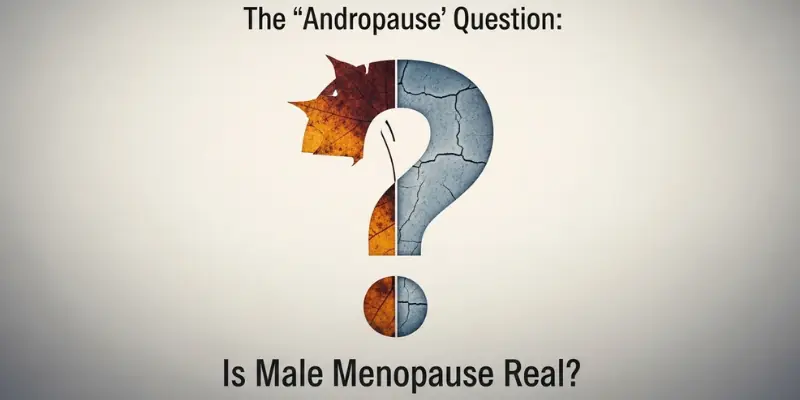
The term ‘andropause’ or ‘male menopause’ is widely used but clinically imprecise. Female menopause is a defined biological event — the cessation of ovarian function and estrogen production, occurring within a specific timeframe, producing a predictable and universal hormonal profile. There is no male equivalent. Testosterone decline in men is gradual, variable, and not universal — many men maintain testosterone well within the normal range into their 70s.
What does exist is late-onset hypogonadism — a clinically significant testosterone deficit in older men that produces real symptoms and responds to treatment. The ‘andropause’ framing can be helpful in communicating the concept to patients, but it risks overmedicalization of normal ageing at one extreme and dismissal of genuine treatable deficiency at the other. The correct framing is clinical: is this man’s testosterone level producing symptoms that are attributable to that level and that are likely to respond to treatment?
The Evidence for Treating LOH: What TRT Does for Older Men
The Testosterone Trials (TTrials)
The most comprehensive evidence base for TRT in older men comes from the Testosterone Trials (TTrials) — a coordinated set of seven randomised, placebo-controlled trials in men 65 years and older with low testosterone (<9.5 nmol/L) and age-related symptoms. Published between 2016 and 2018 in the New England Journal of Medicine and JAMA, these trials examined the effects of one year of testosterone gel versus placebo across multiple outcome domains:
- Sexual function — TRT produced significant improvements in sexual desire, erectile function, and sexual activity compared to placebo
- Physical function — TRT improved walking distance and stair-climbing speed in the physical function trial
- Bone density — TRT significantly increased lumbar spine and femoral neck bone mineral density, with improvements in bone strength estimated from structural analysis
- Anaemia — TRT was highly effective in correcting unexplained anaemia in older hypogonadal men — one of the most striking findings of the entire series
- Mood and depressive symptoms — modest improvement in mood, particularly in men with more significant baseline depressive symptoms
- Cognitive function — no significant cognitive benefit was found in the main cognitive trial, though subgroup analyses suggested possible benefit in men with memory complaints
The TTrials are important not only for what they found but for what they represent: rigorous, placebo-controlled evidence in the exact population most relevant to LOH — older symptomatic men with confirmed low testosterone. Their findings support TRT as an effective treatment for the specific symptom domains in which men with LOH most commonly present.
Beyond Symptoms: Metabolic and Physiological Benefits
In older men, the metabolic benefits of TRT are substantial — visceral fat reduction, improved insulin sensitivity, preservation of lean muscle mass, improved bone density, and reduction of inflammatory markers. These are not merely quality-of-life improvements; they are changes in the underlying biological risk factors for the chronic diseases that dominate morbidity in older men: type 2 diabetes, osteoporosis, sarcopenia, and cardiovascular disease.
The ‘Just Treat Normal Ageing’ Objection — and Why It Misses the Point
A common objection to treating LOH is that it amounts to ‘medicalising normal ageing’ — that testosterone decline is an inevitable biological process and that treating it is an attempt to artificially resist nature. This objection deserves a direct response.
The same logic applied to other age-related conditions would produce absurd clinical positions. Cataracts are a normal consequence of ageing — we treat them. Hypertension increases with age in the majority of the population — we treat it. Bone density declines with age universally — we treat osteoporosis when it crosses a threshold that causes harm. The question is never whether a condition is age-related but whether it is causing significant harm and whether treatment reduces that harm with acceptable risk.
LOH is not the treatment of universal age-related testosterone decline. It is the treatment of testosterone deficiency that crosses a threshold of clinical significance — producing symptoms, physiological consequences, and reduced quality of life — in individual men who are likely to benefit from intervention. This is a clinical judgement, made for individual patients, not a population-wide medicalisation of ageing.
The Clinical Standard for Treatment Decision Treatment is appropriate when: testosterone is consistently below the clinical threshold on correctly timed morning fasting samples; specific symptoms attributable to deficiency are present and causing meaningful impairment; other causes of symptoms have been reasonably excluded; cardiovascular risk and prostate assessment have been completed; and the patient understands the treatment, its monitoring requirements, and its evidence base. This is not ‘treating ageing’ — it is treating a diagnosed clinical condition in an individual patient. |
Practical Considerations for Older Men Starting TRT
Prostate and Cardiovascular Assessment
Pre-treatment PSA, blood pressure, lipid profile, fasting glucose, full blood count, and cardiovascular history are essential baselines before starting TRT in older men — in whom baseline prostate cancer risk and cardiovascular risk are both higher than in younger men. These are not barriers to treatment; they are the clinical prerequisites for safe prescribing.
Haematocrit Monitoring
Erythrocytosis risk on TRT is higher in older men — haematocrit monitoring at 6–8 weeks, 3 months, and 6-monthly thereafter is particularly important in this age group. Baseline haematocrit should be checked before starting and any pre-existing high-normal result noted.
Realistic Expectations
TRT in older men produces real, clinically meaningful improvements in the symptom domains supported by evidence — libido, energy, mood, bone density, body composition, and anaemia where present. It does not reverse ageing or restore a man’s physiology to his 30s. The goal is restoration of the hormonal environment in which quality of life, physical function, and metabolic health are optimised for the individual’s age and biology.
Ongoing Monitoring
Monitoring requirements for older men on TRT are identical in structure to younger men but with heightened attention to PSA, haematocrit, and cardiovascular parameters. Blood pressure, PSA, haematocrit, testosterone levels, and metabolic markers are reviewed at every monitoring appointment.
Frequently Asked Questions
What is late-onset hypogonadism?
Late-onset hypogonadism (LOH) is a clinical syndrome combining biochemically confirmed testosterone deficiency with specific symptoms attributable to that deficiency in older men — typically from the 50s onwards. It is distinct from the universal gradual testosterone decline that occurs with ageing: LOH implies a degree of testosterone deficiency that crosses a threshold of clinical significance, producing symptoms that impair quality of life and that are likely to respond to testosterone replacement therapy.
Is male menopause a real thing?
The term ‘male menopause’ or ‘andropause’ is widely used but clinically imprecise. Unlike female menopause — which is a defined biological event with a predictable hormonal profile — testosterone decline in men is gradual and variable, not universal in its clinical impact. What is real is late-onset hypogonadism: a clinically significant testosterone deficit in older men that produces real symptoms and responds to treatment. The ‘male menopause’ concept is useful for patient communication but overstates the universality and abruptness of the hormonal change.
Is low testosterone in older men just ‘normal ageing’?
Testosterone declines with age in all men — this is normal physiology. But the clinical question is not whether testosterone has declined but whether it has fallen to a level that is causing clinically significant symptoms that are attributable to the deficit. A man with a testosterone of 8 nmol/L who is significantly symptomatic across multiple domains — libido, fatigue, mood, body composition — is not ‘just ageing normally.’ He has a hormonal deficit causing real harm that may be treatable. The ‘it’s just your age’ dismissal conflates universal physiological decline with treatable clinical deficiency.
Is TRT safe for men in their 60s and 70s?
The Testosterone Trials provide the most rigorous evidence: one year of TRT in men 65+ with confirmed low testosterone produced significant improvements in sexual function, physical function, bone density, and anaemia without significantly elevated rates of major adverse cardiovascular events or prostate cancer. Appropriate pre-treatment assessment and sustained monitoring — PSA, haematocrit, blood pressure, lipid profile — are essential in older men and are the foundation of safe prescribing in this age group. Age alone is not a contraindication to TRT.
What symptoms of late-onset hypogonadism are most reliably improved by TRT?
The most reliably improved symptoms in clinical trials are sexual function (libido and erectile function), energy and vitality, mood, bone density, and body composition. Physical function improves modestly. The TTrials also found highly effective correction of unexplained anaemia in older hypogonadal men — one of the most striking findings. Cognitive function showed no significant improvement in the main trial though subgroup analyses suggested possible benefit in men with memory complaints.
How do I know if my low testosterone is causing my symptoms or if it’s just ageing?
The distinguishing features of testosterone-deficiency symptoms versus normal ageing are: disproportionate severity relative to peers; involvement of multiple symptom domains simultaneously (libido, energy, mood, body composition, morning erections); progressive worsening over 2–3 years; persistence regardless of lifestyle optimisation; and — most definitively — improvement on a trial of TRT in men with confirmed biochemical deficiency. A blood test is the essential starting point; it cannot be assessed from symptoms alone.
Will my GP treat late-onset hypogonadism on the NHS?
NHS TRT for late-onset hypogonadism is often difficult to access. NICE guidance acknowledges the condition but NHS commissioners frequently restrict prescribing to men with severe, young-onset, or pathological hypogonadism. Many GPs are unfamiliar with the diagnostic criteria for LOH and default to ‘it’s your age’ for men with borderline or low-normal testosterone. Private TRT clinics such as Vitalis Luxe Clinic in Hull provide assessment and treatment for men who have been unable to access appropriate care through NHS pathways.
Where can I get a late-onset hypogonadism assessment in Hull or Yorkshire?
Vitalis Luxe Clinic in Hull provides comprehensive LOH assessments for men in their 50s, 60s, and beyond — including full hormone panel, PSA, cardiovascular baseline, and symptom assessment. We serve men across Hull, East Yorkshire, and throughout Yorkshire, in person or online with home blood testing. No GP referral required.