





Testosterone and Erectile Dysfunction is a key area of concern when discussing male sexual health, as erectile dysfunction — the persistent inability to achieve or maintain an erection sufficient for satisfactory sexual activity — is one of the most common reasons men come to Vitalis Luxe Clinic in Hull, often alongside concerns about low testosterone. The relationship between testosterone and erectile dysfunction is real, clinically important, and frequently misunderstood — both by men who assume that Testosterone Replacement Therapy is the entire explanation for their erection difficulties, and by those who assume it has nothing to do with their hormones at all.
The truth is more nuanced. Testosterone and ED are necessary for normal erectile function, but it is not sufficient on its own. Erections involve a complex interplay of hormonal, neurological, vascular, and psychological factors — and in most men with erectile dysfunction, multiple components are involved. Understanding which factors are at play in a given man is the key to effective treatment.
In this article, we explain exactly how testosterone contributes to erectile function, what happens to erections when testosterone is deficient, how TRT affects erectile function in men with confirmed deficiency, and when other treatments are needed alongside or instead of TRT.
Table of Contents
How Erections Work: The Physiology
An erection is a neurovascular event — it requires coordinated input from the nervous system, adequate blood flow, functional penile tissue, and appropriate hormonal background. The nitric oxide (NO) pathway is the central mechanism: sexual stimulation (physical or psychological) triggers nitric oxide release from penile nerve terminals and endothelial cells. Nitric oxide activates guanylate cyclase, producing cyclic GMP (cGMP), which relaxes penile smooth muscle and allows arterial blood to flood the corpora cavernosa. The result is engorgement and rigidity.
Phosphodiesterase type 5 (PDE5) breaks down cGMP, ending the erection. PDE5 inhibitors — sildenafil (Viagra), tadalafil (Cialis), vardenafil (Levitra) — work by blocking this breakdown, prolonging cGMP activity. They do not create arousal; they amplify and sustain the nitric oxide response to existing stimulation.
Testosterone’s role in this system is multifaceted and occurs at several points in the pathway.
Testosterone’s Role in Erectile Function
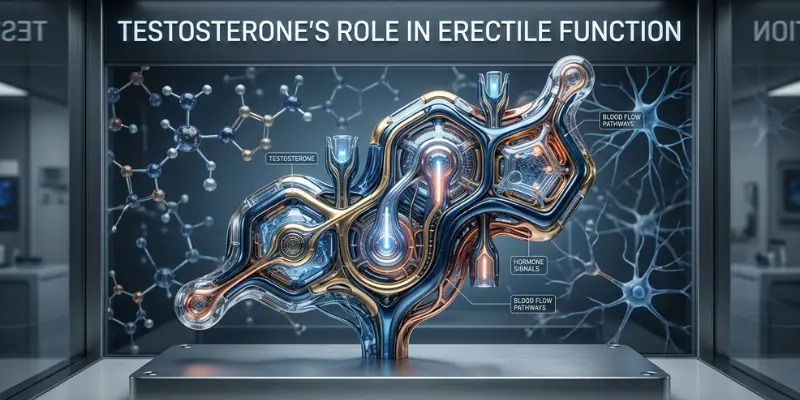
Central: Libido and Sexual Motivation
The most direct role of testosterone in sexual function is central — it drives sexual desire, arousal, and the motivation to pursue sexual activity. Low testosterone typically reduces libido before it significantly affects the mechanics of erection. A man with very low testosterone may be able to achieve an erection with sufficient direct stimulation, but has little desire to pursue it, and without adequate central arousal, the penile response is blunted.
Peripheral: Penile Tissue Health and Nitric Oxide
Testosterone supports the structural and functional health of penile tissue. Androgen receptors are present in penile smooth muscle, and testosterone promotes the expression of nitric oxide synthase (NOS) — the enzyme that produces nitric oxide. When testosterone is chronically deficient, NOS expression declines, nitric oxide production is reduced, and the smooth muscle relaxation necessary for erection is impaired.
Long-standing, severe testosterone deficiency can produce changes in penile tissue — including connective tissue changes and fibrosis — that may not be fully reversible with Testosterone Replacement Therapy alone. This is one reason why identifying and treating testosterone deficiency earlier rather than later produces better erectile outcomes.
Nocturnal Penile Tumescence: The Testosterone-Erection Signal
One of the most clinically useful markers of hormonal erectile function is nocturnal penile tumescence (NPT) — the spontaneous erections that occur during REM sleep. These sleep-related erections are testosterone-dependent and their presence or absence is a reliable signal about the hormonal component of erectile function. Most men are aware of NPT as ‘morning erections.’
Men with testosterone deficiency characteristically experience a reduction or absence of morning erections — often noticed before they become aware of any difficulty with partnered erections. Restoration of morning erections is one of the earliest and most reliable positive signs of TRT working effectively. If morning erections have returned on TRT but partnered erections remain problematic, the residual difficulty is more likely to be vascular, psychological, or both — and may require additional treatment.
How Common Is Erectile Dysfunction in Men with Low Testosterone?
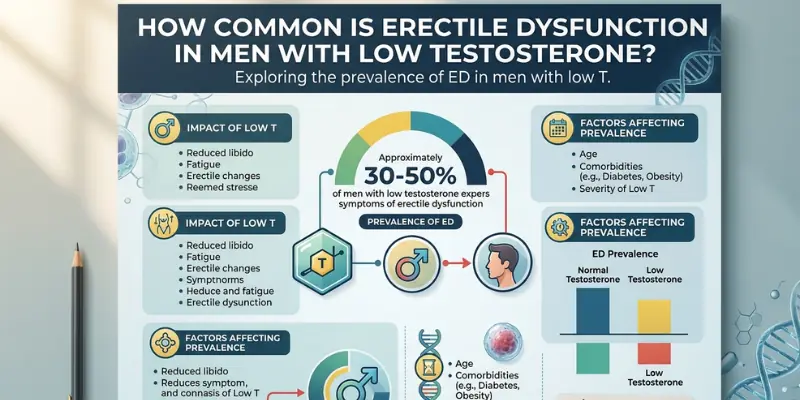
The relationship between testosterone deficiency and erectile dysfunction is well-established but not universal. Not all men with low testosterone develop significant erectile problems — and not all men with erectile dysfunction have low testosterone. The picture is one of contributing factors rather than direct causation in every case.
Clinical Scenario | Testosterone’s Role | Expected TRT Response |
|---|---|---|
Low testosterone + absent/reduced morning erections + reduced libido + ED | Hormonal component strongly implicated | Good — TRT typically restores morning erections and libido; ED often improves significantly |
Low testosterone + present morning erections + reduced libido + ED | Central (libido) component present; vascular/psychological component also likely | Partial — TRT restores libido and may improve ED; a PDE5 inhibitor may be needed for thevascular component |
Normal testosterone + ED + cardiovascular risk factors (diabetes, hypertension, smoking, obesity) | Primarily vascular — testosterone not the primary driver | Limited — TRT unlikely to substantially improve primarily vascular ED; PDE5 inhibitor or further vascular assessment more appropriate |
Low testosterone + ED + significant relationship anxiety or performance anxiety | Hormonal + psychological — both components present | Partial — TRT restores libido and may improve ED; a PDE5 inhibitor may be needed for vascular component |
Low testosterone + ED + obesity + insulin resistance | Metabolic syndrome pattern — multiple interacting factors | Moderate to good with TRT + weight loss + PDE5 inhibitor; comprehensive metabolic approach most effective |
Does TRT Treat Erectile Dysfunction?
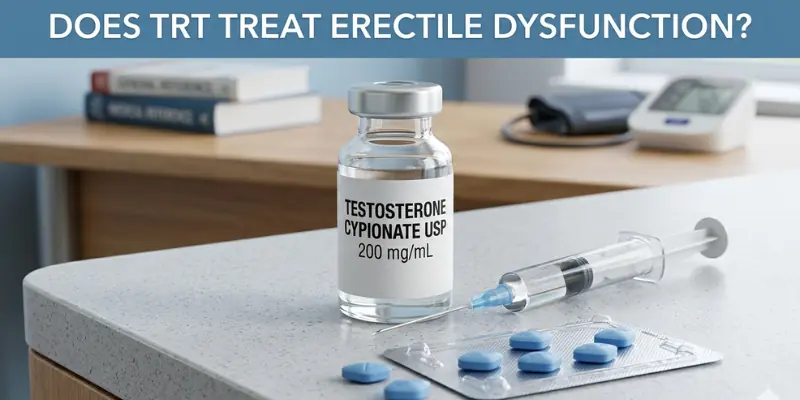
The answer depends critically on the role testosterone deficiency is playing in a given man’s erectile dysfunction — which requires proper assessment to determine.
When TRT Reliably Improves Erectile Function

- Men with clearly deficient testosterone (below 8–10 nmol/L) and erectile dysfunction — particularly when accompanied by absent morning erections and reduced libido — respond well to TRT in terms of erectile outcomes
- Multiple randomised controlled trials demonstrate significant improvement in erectile function scores (IIEF — International Index of Erectile Function) in hypogonadal men on TRT
- TRT improves the central (desire/arousal) component of erectile function most reliably and directly
- TRT restores nitric oxide synthase expression in penile tissue, improving the peripheral mechanism over time, though this takes longer than the libido response
When TRT Alone Is Not Sufficient
- In men with significant vascular disease, diabetes-related nerve damage, or structural penile changes, TRT addresses the hormonal component but does not reverse the underlying vascular or structural pathology
- In men with significant performance anxiety or relationship-based sexual difficulties, TRT improves the hormonal substrate but does not address the psychological factors maintaining the dysfunction
- In men with normal testosterone and erectile dysfunction, TRT is not indicated and will not provide the erectile benefit seen in genuinely hypogonadal men
TRT and PDE5 Inhibitors: The Combination Approach
For many men with testosterone deficiency-related erectile dysfunction — particularly those with mixed hormonal and vascular components — the most effective approach is TRT combined with a PDE5 inhibitor (tadalafil or sildenafil). Research consistently shows that this combination outperforms either treatment alone in men with confirmed testosterone deficiency and ED.
The mechanism is synergistic: TRT restores nitric oxide synthase expression and the central arousal drive; PDE5 inhibitors amplify the nitric oxide signal once it is produced. Tadalafil at a low daily dose (5mg) is particularly compatible with TRT — it provides consistent background support for the nitric oxide pathway without the need for dose timing around sexual activity.
At Vitalis Luxe Clinic, the combination of TRT and low-dose daily tadalafil is a common and highly effective treatment approach for men with testosterone deficiency and erectile dysfunction who want the best possible outcome across all dimensions of sexual function.
The Vascular Component: Why Erectile Dysfunction Is a Cardiovascular Warning Sign
A critical point that every man with erectile dysfunction should understand: erectile dysfunction is an early warning sign of endothelial dysfunction and cardiovascular disease. The penile arteries are small-calibre vessels — among the first to be affected by the atherosclerotic changes that later produce heart attacks and strokes. ED in middle-aged men typically precedes major cardiovascular events by three to five years.
This means that a man presenting with erectile dysfunction — regardless of his testosterone status — deserves a cardiovascular risk assessment: blood pressure, fasting glucose, HbA1c, lipids, smoking history, BMI, and family history. At Vitalis Luxe Clinic, this assessment is standard for all men presenting with erectile dysfunction, because identifying and addressing cardiovascular risk is as important as treating the symptom.
Low testosterone itself is associated with adverse cardiovascular risk factors — increased visceral fat, insulin resistance, adverse lipid profiles, and endothelial dysfunction — creating a hormonal-cardiovascular-erectile triad where all three dimensions reinforce each other. Treating testosterone deficiency comprehensively, including its metabolic and cardiovascular implications, produces the best long-term outcomes for erectile function and overall health.
Psychological Factors: Performance Anxiety and Sexual Confidence
Erectile dysfunction — whatever its original cause — almost inevitably acquires a psychological dimension. The experience of erectile failure, particularly if unexpected, triggers anticipatory anxiety about future performance. This anxiety itself activates the sympathetic nervous system (the ‘fight or flight’ response), which is directly antagonistic to the parasympathetic nervous system activity required for erection. Anticipating failure makes failure more likely — a self-fulfilling cycle.
For men who have had their erectile function restored by TRT and/or PDE5 inhibitors but who continue to struggle with performance anxiety, psychological support — sex therapy, cognitive behavioural therapy focused on sexual function, or couples therapy where relationship factors are involved — is a valuable and often essential component of complete recovery. At Vitalis Luxe Clinic, we recognise this and are able to discuss appropriate referral pathways for psychological support where indicated.
Frequently Asked Questions
Can low testosterone cause erectile dysfunction?
Yes — testosterone deficiency impairs erectile function through multiple mechanisms: reduced libido and central arousal drive, decreased nitric oxide synthase expression in penile tissue (impairing the vascular mechanism of erection), and loss of nocturnal penile tumescence. However, testosterone is one of several factors involved in erectile function, and most men with erectile dysfunction have multiple contributing causes — hormonal, vascular, neurological, and psychological. Proper assessment identifies the relative contribution of each.
Will TRT fix my erectile dysfunction?
TRT significantly improves erectile function in men whose ED has a substantial hormonal component — particularly men with clearly deficient testosterone, absent morning erections, and reduced libido. For men with primarily vascular or psychological ED and normal testosterone, TRT is unlikely to produce a significant benefit. Many men benefit from a combination approach: TRT for the hormonal component and a PDE5 inhibitor (tadalafil, sildenafil) for the vascular component. A clinical assessment determines the most appropriate approach.
Does TRT work better than Viagra for erectile dysfunction?
They address different aspects of the problem and are often most effective in combination. TRT restores the hormonal substrate — libido, nitric oxide synthase expression, morning erections — and is appropriate when testosterone is deficient. PDE5 inhibitors amplify the nitric oxide signal and support the vascular mechanism — they work regardless of testosterone level but do not address hormonal deficiency. In men with both hormonal deficiency and a vascular component, the combination of TRT and low-dose daily tadalafil consistently outperforms either alone.
Why am I on TRT but still have erectile dysfunction?
Several possibilities: the vascular component of your ED requires additional treatment — a PDE5 inhibitor alongside TRT is often the answer; performance anxiety has become an established pattern that requires psychological support; oestradiol may be elevated, impairing sexual function despite adequate testosterone; your testosterone protocol may need dose review; or an underlying cardiovascular or metabolic condition is contributing independently. A clinical review with blood test assessment is the appropriate next step.
What is the link between morning erections and testosterone?
Morning erections (nocturnal penile tumescence) are testosterone-dependent — they occur during REM sleep and are driven by the testosterone surge that accompanies overnight sleep. Reduced or absent morning erections are a characteristic feature of testosterone deficiency and a reliable clinical indicator. Their return on TRT is one of the earliest signs of therapeutic effect. If morning erections remain absent despite adequate testosterone on treatment, a vascular or structural cause should be evaluated.
Can erectile dysfunction be a sign of heart disease?
Yes — this is an important and underrecognised clinical fact. The penile arteries are small-calibre vessels and are among the first affected by atherosclerotic changes that later produce cardiovascular events. ED in men over 40 without an obvious cause typically precedes major cardiovascular events by three to five years. All men presenting with ED should have a cardiovascular risk assessment — blood pressure, glucose, lipids, BMI, smoking history. At Vitalis Luxe Clinic, this is standard clinical practice for every man presenting with ED.
Does testosterone affect libido differently from erectile function?
Yes — testosterone affects libido (sexual desire and motivation) more directly and reliably than it affects the mechanical aspects of erection. Libido is centrally mediated through testosterone’s effects on dopaminergic and brain androgen receptor systems. Erection also requires adequate vascular function, peripheral nitric oxide activity, and psychological factors. TRT typically restores libido more rapidly and completely than it restores full erectile function — particularly when vascular or psychological components of ED are also present.
Where can I discuss erectile dysfunction and testosterone in Hull or Yorkshire?
Vitalis Luxe Clinic in Hull provides confidential, comprehensive assessments for men with erectile dysfunction and suspected testosterone deficiency across Hull, East Yorkshire, and throughout Yorkshire. Our consultations include hormone assessment, cardiovascular risk evaluation, and a full discussion of treatment options — including TRT, PDE5 inhibitors, and combination approaches. No GP referral required.