



One of the most common questions we receive at Vitalis Luxe Clinic in Hull is a simple one: ‘My test result came back at X nmol/L, is that normal?’ And the answer, it turns out, is more nuanced than a simple reference range can capture. Testosterone levels vary significantly by age, by the time of day blood is drawn, by the laboratory assay used, and critically by whether the number on a report corresponds to how a man actually feels.
In this article, we provide the UK clinical reference ranges for testosterone by age under the focus keyword Normal Testosterone Levels by Age, explain what those ranges mean in practice, clarify the important distinction between total and free testosterone, and help men understand when a result that falls within the “normal” range may still represent a clinically relevant hormonal deficiency, as well as when a result below range may be explained by factors unrelated to genuine hypogonadism.
This is a reference guide written to be genuinely useful, not a substitute for clinical assessment, but the starting point for an informed conversation about your results.
How Testosterone Is Measured: Units and Assay Methods

The Units
In the UK, testosterone is most commonly reported in nmol/L (nanomoles per litre). In the United States, ng/dL (nanograms per decilitre) is standard. The conversion is: 1 nmol/L = 28.8 ng/dL, or approximately 1 ng/dL = 0.0347 nmol/L. Online resources frequently use ng/dL; UK blood test results use nmol/L. Confusion between the two units is common and can lead to significant misinterpretation of results.
Total vs. Free Testosterone

Standard NHS and private blood tests report total testosterone — the combined measurement of all testosterone in the blood, regardless of whether it is bound to proteins or biologically active. However, only a fraction of total testosterone is biologically available to act on tissues:
- Approximately 40–50% is tightly bound to sex hormone-binding globulin (SHBG) — this fraction is essentially inactive
- Approximately 50–54% is loosely bound to albumin — this fraction is biologically available
- Approximately 2–3% is completely unbound (free testosterone) — immediately biologically active
The free testosterone and albumin-bound fractions together constitute ‘bioavailable testosterone’ — the portion that can actually enter cells and exert androgenic effects. When SHBG is very high (as it commonly is in older men, in men with hyperthyroidism, or in men on certain medications), total testosterone may appear adequate while free testosterone and therefore actual androgenic activity is subtherapeutic.
A comprehensive testosterone assessment measures both total testosterone and, ideally, SHBG from which free testosterone can be calculated rather than relying on total testosterone alone.
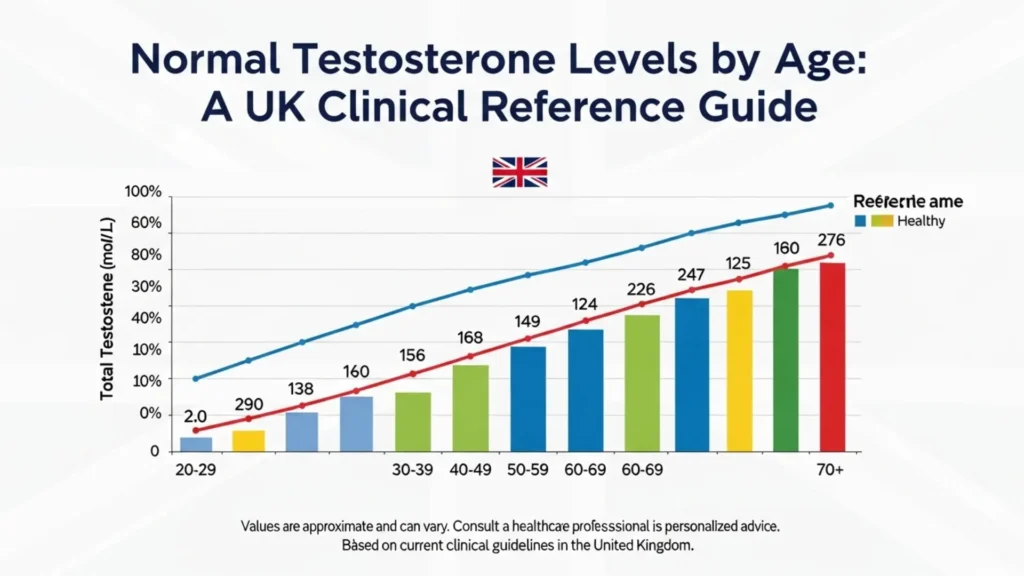
UK Reference Ranges for Total Testosterone by Age

The following reference ranges are based on UK laboratory standards and the British Society for Sexual Medicine (BSSM) guidelines. They represent the range found in a population of healthy men at each age decade — not the optimal level for every individual, but the statistical distribution of the population.
The Clinical Thresholds That Actually Matter

UK clinical guidelines — including those from the BSSM and the European Academy of Andrology — identify the following clinically relevant thresholds:
Why Testosterone Declines with Age

The decline in testosterone with age is neither sudden nor uniform — it follows a gradual trajectory driven by multiple interacting mechanisms:
Leydig Cell Decline
The Leydig cells in the testes — the primary source of testosterone production — progressively decrease in number and steroidogenic capacity with age. This is a normal biological process, but its pace varies substantially between individuals. Men who maintain good health, body composition, sleep quality, and physical activity into later decades preserve Leydig cell function better than those who do not.
Rising SHBG
Sex hormone-binding globulin rises progressively with age in most men — the mechanism is multifactorial and includes changes in liver function, reduced growth hormone, and other age-related hormonal shifts. As SHBG rises, a greater proportion of total testosterone is bound and inactivated. The net effect: free testosterone falls faster than total testosterone with age. A 60-year-old man with total testosterone of 14 nmol/L may have free testosterone equivalent to clinical deficiency, because a high SHBG is capturing most of what is produced.
HPG Axis Changes
The pulsatile release of GnRH from the hypothalamus — which drives LH and FSH release and therefore testicular stimulation — becomes less robust with age. The amplitude of LH pulses decreases, and the testicular response to LH diminishes. This central component of age-related testosterone decline means that the HPG axis itself becomes a less efficient driver of testosterone production over time.
Lifestyle and Health Factors Accelerating Decline
- Increasing visceral adiposity — the aromatase in fat tissue converts testosterone to oestradiol, suppressing HPG axis feedback further
- Chronic sleep restriction — the overnight testosterone production window is progressively more important to protect as age-related decline proceeds
- Chronic disease burden — type 2 diabetes, cardiovascular disease, and chronic inflammatory conditions are all associated with accelerated testosterone decline
- Medications — opioids, corticosteroids, certain antidepressants, and many other common medications can suppress testosterone, compounding age-related decline
Free Testosterone: The Number That Often Matters More
For men in the borderline or low-normal total testosterone range — particularly those who are symptomatic despite a result that nominally appears ‘in range’ — free testosterone is the more clinically meaningful measure. It can be directly measured (using equilibrium dialysis — the gold standard but expensive and not widely available) or calculated from total testosterone and SHBG (the approach used in most clinical settings).
The free testosterone calculation requires both a total testosterone and SHBG measurement on the same blood sample. At Vitalis Luxe Clinic, this is part of the standard comprehensive panel — because total testosterone alone provides an incomplete picture in a significant proportion of men.
Why Timing of the Blood Test Matters
Testosterone follows a strong diurnal rhythm — levels are highest in the early morning (approximately 7–10am) and fall by 20–35% over the course of the day, reaching their lowest in the afternoon and evening. UK and international guidelines recommend that testosterone testing for diagnostic purposes is performed on a fasting morning sample, ideally before 10am.
A testosterone result taken at 2pm may be 20–35% lower than the same man’s early morning level — potentially creating a false impression of deficiency in a man who is actually in the normal range when appropriately timed, or — critically — may fail to identify deficiency in a man whose morning level is already borderline. An afternoon result that appears borderline should always be repeated as a morning sample before clinical conclusions are drawn
Frequently Asked Questions
What is a normal testosterone level for a man in the UK?
The normal range for adult men in UK laboratories is typically reported as 8–30 nmol/L (approximately 230–860 ng/dL), though ranges vary slightly between laboratories. The upper range is higher in young men (up to 35–40 nmol/L in their 20s) and falls progressively with age. A result within this range does not automatically mean testosterone is adequate for a specific individual — symptoms, free testosterone, and the clinical context determine whether a result is clinically relevant.
What testosterone level is considered low in the UK?
UK clinical guidelines (BSSM) identify below 8 nmol/L (approximately 230 ng/dL) total testosterone as a clear clinical threshold for deficiency in symptomatic men. The borderline range of 8–12 nmol/L requires assessment of free testosterone, SHBG, symptoms, and LH/FSH before a clinical decision is made. Some symptomatic men with total testosterone above 12 nmol/L have subtherapeutic free testosterone due to elevated SHBG.
How does testosterone change with age in men?
Testosterone declines gradually from peak levels in the late teens and twenties — typically falling at approximately 1–2% per year from the mid-thirties onwards. By the 50s, many men are in the lower portion of the reference range; by their 60s and 70s, a significant proportion are in the borderline or deficient range. SHBG rises with age, meaning free testosterone falls faster than total testosterone — the biologically relevant decline is steeper than total testosterone figures suggest.
What is the difference between total and free testosterone?
Total testosterone measures all testosterone in the blood — both bound and unbound. The majority is bound to proteins (SHBG and albumin), with only 2–3% free and immediately active. Free testosterone — together with the albumin-bound fraction — is the biologically available testosterone that can enter cells and exert androgenic effects. When SHBG is elevated, total testosterone may appear adequate while free testosterone is significantly reduced. A comprehensive assessment measures both.
Can testosterone be ‘normal’ but still too low?
Yes this is one of the most important clinical nuances in testosterone assessment. Laboratory ‘normal’ ranges are derived from population statistics and are deliberately wide to include the majority of the population. A man in the lowest 10–15% of the range may be genuinely symptomatic despite a result that is technically ‘within range.’ The clinical picture — symptoms, free testosterone, SHBG, diurnal testing — determines whether treatment is warranted, not the report alone.