






The Question Every Patient Asks Me
Every week at Vitalis Luxe Clinic, I hear the same concern: “Doctor, if I go on TRT, will I go bald?” It’s one of the most common fears men have before starting Testosterone Replacement Therapy—and honestly, it deserves a clear, science-backed answer. The real question behind this concern is: Does High Testosterone Cause Hair Loss? Understanding the relationship between testosterone, genetics, and hair follicles is key to separating myth from fact before making any treatment decisions.
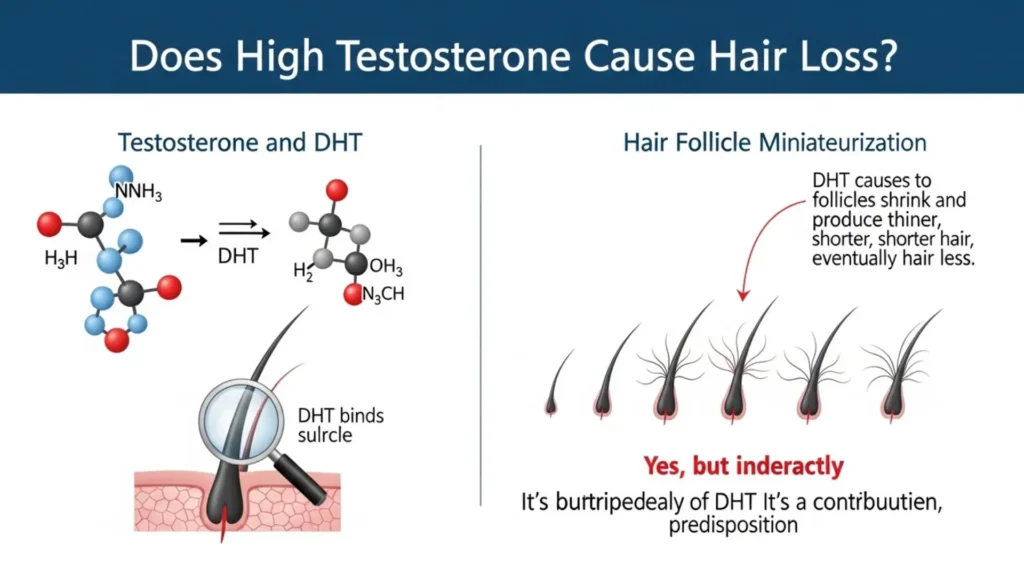
The short answer? High testosterone itself does not directly cause hair loss. The real culprit is a hormone called DHT (dihydrotestosterone) — and even then, only in men who are genetically predisposed to hair loss. Let me explain exactly how this works.
What Is DHT and How Is It Connected to Testosterone?
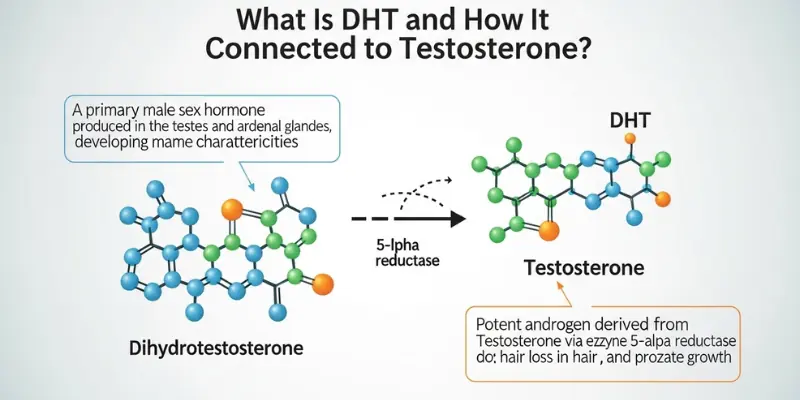
Testosterone is your body’s primary male hormone. It controls energy, muscle mass, mood, libido, and much more. A small portion of testosterone is converted by an enzyme called 5-alpha reductase (5-AR) into a more potent hormone — DHT.
Key fact: DHT binds to androgen receptors in hair follicles with approximately five times greater affinity than testosterone itself.
When DHT binds to hair follicle receptors repeatedly, it causes a process called follicular miniaturisation — the follicles gradually shrink, producing thinner and shorter hairs until they eventually stop producing hair altogether. This is the biological foundation of Androgenetic Alopecia (AGA), commonly known as male pattern baldness.
Quick Summary: Testosterone vs DHT vs Hair Loss
| Factor | Role in Hair Loss | Key Point |
|---|---|---|
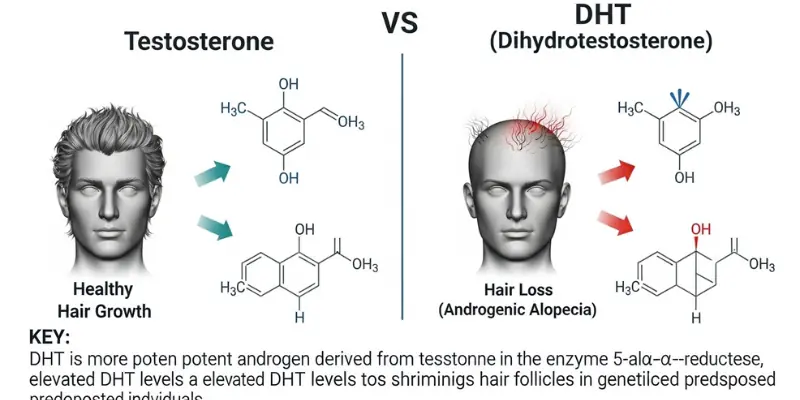
| Testosterone | Indirect — converted to DHT | High T alone does not cause baldness |
| DHT | Primary driver of follicle miniaturisation | 5x stronger binding to hair follicle receptors |
| Genetics | Determines follicle sensitivity to DHT | Accounts for ~80% of baldness risk |
| 5-Alpha Reductase | Enzyme that converts T to DHT | Activity is higher in balding scalp tissue |
Why Genetics Matters More Than You Think
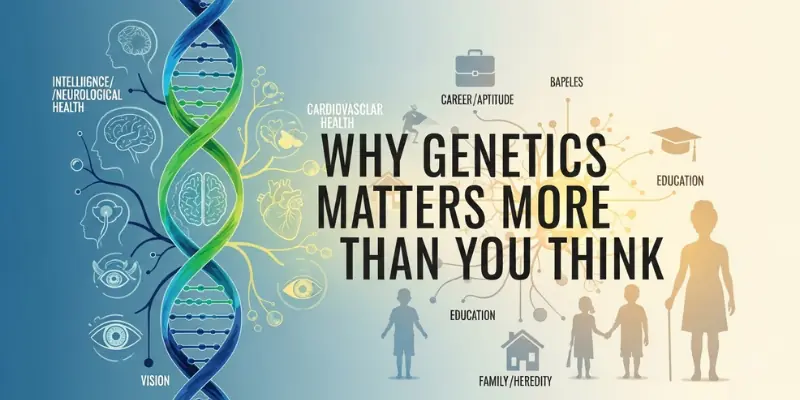
Here is something that surprises many of my patients: two men with identical testosterone levels can have completely different hairlines. One man goes bald in his twenties; the other keeps a full head of hair into his sixties.
Why? Because what truly determines whether you lose your hair is not how much testosterone or DHT you produce — it is how sensitive your hair follicles are to DHT. And that sensitivity is largely determined by your genetics.
Twin studies and family analyses have confirmed that genetic factors account for approximately 80% of the risk for androgenetic alopecia. Variations in the AR gene (androgen receptor gene) — particularly on the X chromosome inherited from your mother’s side — can result in receptors that are far more easily stimulated by DHT than normal.
Clinical insight from Dr Naveed: I have patients with perfectly normal testosterone levels who experience significant hair loss and patients on TRT whose hair is completely unaffected. Genetics is the decisive variable.
Does TRT Cause Hair Loss?
This is the question most directly relevant to men considering or already on Testosterone Replacement Therapy. The honest answer is: it depends.
TRT can raise DHT levels because more circulating testosterone gives the 5-AR enzyme more substrate to work with. In men who are genetically prone to androgenetic alopecia, this may accelerate the hair loss process that was already likely to occur. However, TRT does not cause hair loss in men without the genetic predisposition.
TRT and Hair Loss: What the Evidence Shows
| Patient Profile | Risk of Hair Loss on TRT | Recommended Action |
|---|---|---|
| No family history of baldness, no current hair loss | Low | Proceed with TRT; monitor DHT levels |
| Family history of AGA but no current loss | Moderate | Discuss DHT-blocking options before starting TRT |
| Existing hair thinning / active AGA | Higher | Combine TRT with targeted hair loss management plan |
At Vitalis Luxe Clinic, before commencing any TRT protocol, we assess your complete hormonal profile — including DHT and free testosterone — alongside your personal and family history. This allows us to tailor your treatment plan and proactively manage any hair-related concerns.
Learn more about trt myths.
How DHT Causes Hair Loss: The Step-by-Step Process
Understanding the mechanism helps you make informed decisions about your treatment options.
- DHT is produced: The 5-alpha reductase enzyme converts testosterone into DHT in various tissues, including the scalp.
- DHT binds to follicle receptors: In men with genetic sensitivity, DHT attaches to androgen receptors in hair follicles far more readily.
- Anagen phase shortens: The active growth phase of hair becomes progressively shorter with each cycle.
- Follicular miniaturisation begins: Hairs produced become progressively finer, shorter, and lighter in colour.
- The follicle eventually becomes dormant: Without intervention, the follicle stops producing visible hair altogether.
The Normal Hair Growth Cycle vs DHT-Affected Cycle
| Phase | Normal Duration | DHT-Affected Duration |
|---|---|---|
| Anagen (Growth) | 2–6 years | Progressively shortened (weeks to months) |
| Catagen (Transition) | 2–3 weeks | May occur earlier |
| Telogen (Resting) | 3 months | Extended — delays regrowth |
| Net result | Full, healthy hair strand | Shorter, thinner hair; eventual dormancy |
Common Myths — Debunked by Dr Naveed
Myth 1: Bald men have more testosterone
Not true. Research consistently shows that bald men do not have significantly higher systemic testosterone than men with full hair. The difference lies in local DHT activity and follicle sensitivity — not total testosterone output.
Myth 2: If I avoid TRT, I will keep my hair
If you are genetically predisposed to androgenetic alopecia, hair loss will likely occur regardless of TRT. Your natural testosterone production already creates the DHT that affects susceptible follicles. TRT may influence the rate of progression, not the underlying inevitability.
Myth 3: There is nothing you can do about it
Absolutely not. There are well-evidenced medical interventions — including 5-alpha reductase inhibitors (finasteride, dutasteride) and topical minoxidil — that have been clinically proven to slow progression and, in many cases, partially reverse follicular miniaturisation. At Vitalis Luxe, we build these into your treatment plan when appropriate.
How We Manage This at Vitalis Luxe Clinic
At Vitalis Luxe Clinic, hair health is part of every TRT consultation. We take a proactive, personalised approach rather than waiting for concerns to arise.
- Comprehensive hormone panel: We measure total testosterone, free testosterone, DHT, SHBG, and other key markers before and during treatment.
- Personal and family history review: We assess your genetic risk profile for androgenetic alopecia as part of our initial assessment.
- Tailored TRT protocol: We select the delivery method (injectable, gel, or oral) and dosage that best balances your hormonal goals with your individual risk profile.
- Integrated hair loss management: Where clinically appropriate, we can incorporate DHT-blocking medications or topical treatments alongside your TRT.
- Ongoing monitoring: Regular follow-up appointments and blood panels ensure your DHT levels remain within a well-managed range throughout your treatment.
At Vitalis Luxe, we believe that optimising your testosterone levels and protecting your hair are not mutually exclusive. With the right clinical approach, you can achieve both.
Ready to Get Your Hormones Checked?
If you are concerned about hair loss, low testosterone, or the relationship between the two, the first step is always a proper hormonal blood test and consultation. At Vitalis Luxe Clinic, we offer expert, discreet, evidence-based care for men across Hull and Yorkshire.
Do not make assumptions about your hormone health — get the facts, understand your personal risk, and take control of your wellbeing with a team that genuinely specialises in men’s hormonal health.
Frequently Asked Questions
1. Does high testosterone directly cause hair loss?
No. High testosterone itself does not directly cause hair loss. The real driver is DHT (dihydrotestosterone) a hormone converted from testosterone and even then, only in men who are genetically predisposed to androgenetic alopecia.
2. Will TRT make me go bald?
It depends on your genetics. TRT can raise DHT levels, which may accelerate hair loss in men already genetically prone to it. However, men without a genetic predisposition to baldness are at low risk of hair loss from TRT. A proper hormonal assessment before starting treatment is essential.
3. Do bald men have higher testosterone levels?
No — this is a common myth. Research consistently shows that bald men do not have significantly higher systemic testosterone than men with a full head of hair. The key difference lies in local DHT activity and how sensitive the hair follicles are to it, not total testosterone levels.
4. Can hair loss from DHT be treated or reversed?
Yes. There are clinically proven treatments, including 5-alpha reductase inhibitors such as finasteride and dutasteride, as well as topical minoxidil, that can slow the progression of hair loss and in many cases partially reverse follicular miniaturisation when started early enough.
5. How does Vitalis Luxe Clinic manage hair loss risk in TRT patients?
Before starting any TRT protocol, Vitalis Luxe Clinic conducts a comprehensive hormone panel measuring DHT, free testosterone, and SHBG, alongside a full personal and family history review. Where appropriate, DHT-blocking medications or topical treatments are incorporated into the treatment plan alongside TRT, with ongoing monitoring throughout.