






When men come to Vitalis Luxe Clinic in Hull to discuss testosterone replacement therapy, one of the first practical questions is almost always: what form will the treatment actually take? The choice between injectable testosterone, gels, creams, and other preparations is not merely a matter of preference — it has meaningful clinical implications for how well testosterone levels are maintained, how the body metabolises the hormone, how side effects are managed, and how compatible treatment is with a man’s daily life.
Learn more about trt treatment options.
There is no universally superior preparation. The right choice depends on the individual — his clinical profile, lifestyle, priorities, and preferences. What matters is that the decision is made with a complete understanding of what each preparation offers, what it demands, and where its limitations lie.
In this article, we compare every major Types of TRT preparation type used in clinical practice in the UK — injections, gels, creams, and pellets — with the clinical honesty and practical detail that makes the difference between a treatment that works for someone’s life and one that doesn’t.
Table of Contents
Why Preparation Choice Matters Clinically

All TRT preparations deliver the same active molecule — testosterone — but they differ substantially in how that molecule reaches the bloodstream, how stable levels are maintained, what peak-to-trough variation occurs, how the body converts testosterone to its metabolites (DHT and oestradiol), and what the practical demands of administration are. These differences have real clinical consequences:
- Pharmacokinetic profile — how quickly levels rise, how high they peak, how far they fall between doses, and how stable the steady-state is
- DHT conversion — injectable testosterone and transdermal preparations differ in how much DHT is produced; this affects hair loss risk, acne, and prostate considerations
- Erythrocytosis risk — different preparations carry different haematocrit elevation risks due to their pharmacokinetic profiles
- Transfer risk — some transdermal preparations can transfer to partners or children through skin contact
- Adherence and lifestyle compatibility — a preparation that theoretically provides ideal pharmacokinetics but that a patient won’t use consistently is clinically inferior to a less perfect preparation he will actually use every day
Injectable Testosterone
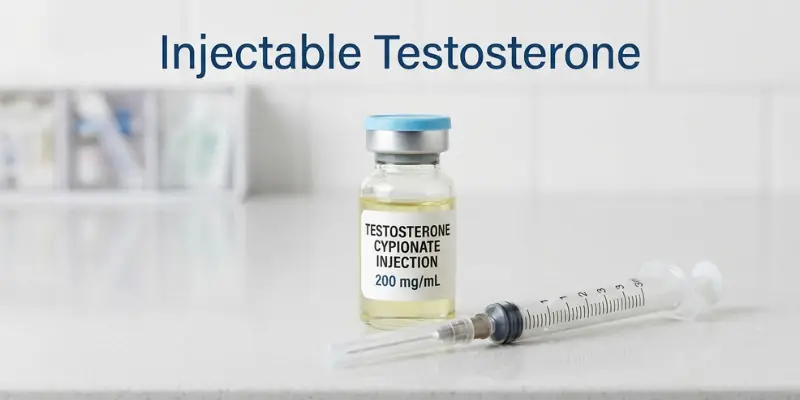
Injectable testosterone is the most widely used preparation in UK private TRT clinical practice and is the form used at Vitalis Luxe Clinic for the majority of patients. It is prescribed as a solution drawn into a syringe and injected into muscle (intramuscular — IM) or subcutaneous fat (subcutaneous — SC).
Available Preparations
| Injectable Preparation | Ester | Half-life (approx.) | Typical Frequency | UK Availability |
|---|---|---|---|---|
| Testosterone enanthate (e.g. Testogel — note: also available as Nebido) | Enanthate | 4–5 days | Weekly or twice-weekly | Widely available; most common UK injectable TRT preparation |
| Testosterone cypionate | Cypionate | 5–6 days | Weekly or twice-weekly | Less common in UK than in US; available from some UK private clinics |
| Testosterone undecanoate (Nebido) | Undecanoate | 90+ days | Every 10–14 weeks | Licensed UK preparation; used in NHS and some private settings |
| Testosterone propionate | Propionate | 1–2 days | Every 1–3 days | Less common; very short half-life requires frequent dosing |
| Sustanon 250 (mixed esters) | Multiple esters | Variable | Every 1–3 weeks (though often sub-optimal at this frequency) | Licensed UK preparation; historically common; being superseded by mono-ester protocols |
Why Weekly or Twice-Weekly Enanthate Is the Most Commonly Used Protocol

Testosterone enanthate with a half-life of approximately four to five days, injected weekly or twice-weekly (the latter producing more stable levels with smaller peak-to-trough variation), delivers a very predictable and adjustable pharmacokinetic profile. Levels can be measured and calibrated reliably. Dose adjustments produce predictable level changes. The injection frequency is manageable for most men with basic technique training.
Subcutaneous injection — into the fatty layer of the abdomen or outer thigh — is increasingly favoured over intramuscular injection for self-administration. It is less painful, has a lower risk of injection site bruising, produces slightly more stable levels due to slower absorption, and is significantly easier for most men to perform at home. At Vitalis Luxe Clinic, we train patients in subcutaneous injection technique as standard.
Nebido: The Long-Acting Alternative

Testosterone undecanoate (Nebido) is a long-acting injectable preparation administered every 10–14 weeks. Its appeal is obvious: two to four injections per year instead of 52 weekly injections. In practice, Nebido has significant clinical limitations that make it less suitable for most privately managed TRT:
- Very slow onset to stable levels — it can take six months or more to achieve stable therapeutic testosterone levels from Nebido initiation
- Significant peak-to-trough variation — testosterone levels are substantially higher in the weeks immediately following injection and may fall below therapeutic range toward the end of the dosing interval
- Limited dose-adjustment flexibility — the very long half-life makes it difficult to respond quickly to emerging side effects or suboptimal levels
- Poor fit with regular monitoring — the 10–14 week interval makes it difficult to correlate blood tests with clinical response in the way that shorter-acting preparations allow
Nebido remains useful for specific clinical situations — particularly men who cannot self-inject and who have stable levels on established dosing. But for most men beginning TRT and seeking optimal control and dose flexibility, shorter-acting preparations are preferable.
Injection Advantages and Disadvantages

| Injections: Advantages | Injections: Disadvantages |
|---|---|
| Most cost-effective preparation long-term | Requires learning injection technique (typically resolved quickly with training) |
| Most controllable and adjustable pharmacokinetics | Injection site soreness or bruising in some men, particularly early on |
| No skin transfer risk | Some men have psychological discomfort with self-injection initially |
| Reliable absorption — not affected by skin hydration, application site, or bathing | Peak-to-trough variation (minimised with twice-weekly dosing) |
| Straightforward monitoring: dose-level relationship is predictable | Haematocrit risk slightly higher than transdermal preparations |
| No daily application required | Requires sharps disposal (bins provided) |
Testosterone Gels
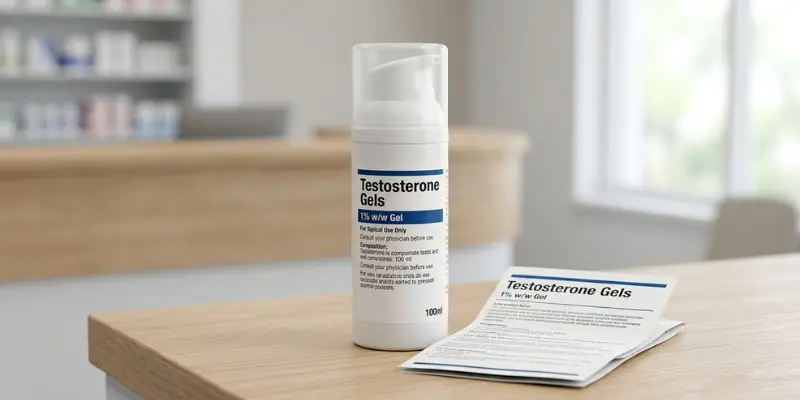
Testosterone gels are applied daily to the skin — typically to the shoulders, upper arms, or abdomen — and absorbed transdermally into the bloodstream. They are the most widely prescribed TRT preparation in primary care settings in the UK (brands include Testogel and Tostran) and are familiar to many men who have received a testosterone prescription from their GP.
How Gels Work
Daily transdermal absorption bypasses the first-pass hepatic metabolism that would occur with oral preparations, delivering testosterone directly to the circulation. The absorption rate varies between individuals — some men are efficient absorbers who achieve good levels with standard doses, while others absorb poorly and achieve subtherapeutic levels even on maximum-dose gel preparations.
A key feature of gels is that the conversion of testosterone to DHT is higher for transdermal preparations than for injectable testosterone, because more conversion occurs in the skin via the Type 1 5-alpha reductase isoform present in the dermis. For men with significant concerns about hair loss or prostate health, this is a relevant consideration — though it is manageable with monitoring.
Gel Advantages and Disadvantages
| Gels: Advantages | Gels: Disadvantages |
|---|---|
| No injections — suitable for men with needle aversion | Must be applied daily without exception; missed doses affect levels |
| Stable daily levels without peak-to-trough injection variation | Skin transfer risk — must not be applied near partners or children; hands washed; application site covered |
| Familiar and widely licensed in UK — NHS and private | Variable absorption — some men achieve subtherapeutic levels even on maximum doses |
| Easy application routine for most men | Higher DHT conversion than injectable — relevant for hair and prostate considerations |
| Lower haematocrit risk than injections | Cannot be used immediately before swimming, showering (wait 2–6 hours by preparation) |
| Can be used in men who cannot self-inject | Cost may be higher than injectable preparations for equivalent clinical effect |
Testosterone Creams
Testosterone creams — compounded or commercially prepared — are applied to scrotal or non-scrotal skin and absorbed transdermally. Scrotal application is increasingly used at specialised TRT clinics due to the significantly higher absorption efficiency of scrotal skin compared to other application sites.
Scrotal Testosterone Cream
Scrotal skin has a unique property: it is highly permeable to testosterone — significantly more so than the skin of the shoulder or abdomen. Applying testosterone cream to the scrotum produces higher testosterone absorption from smaller doses, and — importantly — also produces substantially higher DHT levels due to the high concentration of 5-alpha reductase in scrotal tissue.
This DHT elevation is intentional in some clinical protocols — DHT has important effects on libido, mood, and cognitive function that some men respond to particularly well. For men with significant genetic predisposition to androgenetic alopecia or prostate concerns, however, the substantially elevated DHT from scrotal cream application requires careful consideration and discussion.
Cream Advantages and Disadvantages
| Creams: Advantages | Creams: Disadvantages |
|---|---|
| Very high absorption efficiency (especially scrotal) | DHT levels significantly elevated with scrotal application — hair and prostate considerations more prominent |
| Small volumes required for therapeutic levels | Application site (scrotum) is less convenient than shoulder/abdomen for some men |
| Good stable daily levels | Compounded preparations not always available through standard pharmacy channels |
| Some men respond very well to DHT-mediated effects (mood, libido, cognitive) | Requires daily application; skin transfer risk applies as with gels |
| Avoids injections | Less pharmacokinetic data than long-established injectable preparations |
Testosterone Pellets (Implants)
Testosterone pellets are small crystalline pellets inserted subcutaneously — typically in the upper buttock or abdomen — by a clinician through a minor in-office procedure. They dissolve slowly over three to six months, releasing testosterone at a steady rate. They are more widely used in the United States than in the UK, where their availability is limited.
Pellet Advantages and Disadvantages
| Pellets: Advantages | Pellets: Disadvantages |
|---|---|
| Set-and-forget — no daily or weekly administration required | Minor surgical procedure for insertion; rare risk of infection or extrusion |
| Very stable, consistent testosterone delivery over months | Not easily adjustable — if dose is wrong or side effects occur, cannot be quickly corrected |
| No skin transfer risk | Limited availability in UK private practice |
| Suitable for men who cannot or will not self-administer | Cannot accommodate the rapid dose adjustments needed when optimising treatment in the first year |
| No sharps or daily application routine | Insertion procedure cost and inconvenience every 3–6 months |
For most men initiating TRT in the UK, pellets are not the first-choice preparation — the lack of dose flexibility during the critical optimisation period of the first 6–12 months is a significant clinical disadvantage. They may be a reasonable option for men who are stable on a well-established dose and who have strong lifestyle reasons to prefer infrequent administration.
The Comprehensive Preparation Comparison
| Feature | Injections (weekly/2x weekly) | Gels (daily) | Scrotal Cream (daily) | Pellets (3–6 monthly) |
|---|---|---|---|---|
| Administration frequency | Weekly or twice-weekly | Daily | Daily | Every 3–6 months (clinician insertion) |
| Level stability | Good with twice-weekly; moderate with weekly | Excellent daily stability | Excellent daily stability | Excellent — very steady |
| DHT conversion | Moderate | Higher than injections | Highest (scrotal 5AR) | Moderate |
| Haematocrit risk | Higher | Lower | Lower | Moderate |
| Dose adjustability | Excellent — immediate | Good — increase dose or change site | Good — increase dose | Poor — cannot adjust until next pellet |
| Skin transfer risk | None | Yes — precautions needed | Yes — precautions needed | None |
| Cost (approximate UK) | Lowest | Moderate | Moderate–higher (compounded) | Higher (procedure cost) |
| Suitable for needle aversion | No | Yes | Yes | Yes (clinician-administered) |
| UK availability | Very widely available | Widely available (NHS and private) | Available at specialist private clinics | Limited UK availability |
This section compares injections, gels, creams and pellets and already includes UK availability and approximate UK cost, so it naturally leads into your broader TRT UK guide.
How We Choose at Vitalis Luxe Clinic
At our Hull clinic, the choice of TRT preparation is made collaboratively with each patient — informed by his clinical profile, lifestyle, preferences, and the clinical considerations that make one preparation better suited to his situation than another.
- Men with no needle aversion and a straightforward clinical profile typically start on subcutaneous testosterone enanthate — it provides the best control, adjustability, and pharmacokinetic predictability
- Men with a strong dislike of needles or who cannot self-inject are offered gel or cream preparations, with a discussion of the DHT and skin transfer considerations
- Men with significant hair loss concerns or prostate health history are counselled more carefully on DHT conversion profiles of each preparation
- Men who are stable on established doses after 12+ months of TRT may be considered for longer-acting alternatives if lifestyle makes frequency reduction a priority
- Preparation switches are available and common — men who start on one form and find it suboptimal in practice can switch, with clinical guidance, to another
No preparation is inherently superior. The superior preparation is the one that delivers stable, therapeutic testosterone levels for the individual man, fits sustainably into his daily life, and produces a side effect profile that is manageable within a properly monitored programme.
Frequently Asked Questions
What is the best form of TRT?
There is no universally best form. For most men in UK clinical practice, subcutaneous testosterone enanthate (weekly or twice-weekly) provides the best combination of pharmacokinetic control, dose adjustability, monitoring compatibility, and cost-effectiveness. However, for men with needle aversion, specific DHT concerns, or lifestyle factors that make daily topical application preferable, gels or creams may be more appropriate. The best form is the one that is clinically appropriate, sustainably used, and properly monitored.
Are testosterone injections better than gels?
For most men, injections provide superior pharmacokinetic control — more predictable levels, easier dose adjustment, lower skin transfer risk, and generally lower cost. However, gels provide excellent daily level stability, require no injection technique, and are suitable for men who cannot or will not self-inject. The clinical question is not which is abstractly better but which is better for the individual patient’s profile and preferences.
What is subcutaneous testosterone injection?
Subcutaneous injection delivers testosterone into the fat layer just beneath the skin — typically the abdomen or outer thigh — rather than into muscle. It is increasingly favoured for self-administered TRT because it is less painful than intramuscular injection, produces slightly slower and more stable absorption, carries lower risk of bruising, and is significantly easier for most men to perform at home. At Vitalis Luxe Clinic, subcutaneous injection training is provided as standard for patients starting injectable TRT.
Does testosterone gel transfer to partners?
Yes — this is a real risk that requires active management. Testosterone gel applied to the skin can transfer to partners or children through direct skin contact before it is fully absorbed. The standard precautions are: applying to a covered area (shoulders or abdomen under clothing), washing hands immediately after application, and avoiding skin-to-skin contact at the application site for at least two to six hours (preparation-dependent). Women exposed to testosterone through transfer can develop virilising side effects; children are particularly vulnerable to androgenic effects.
Are testosterone pellets available in the UK?
Testosterone pellets have limited availability in the UK compared to the United States, where they are more widely used. Some private clinics do offer pellet implantation, but they are not the standard preparation in UK private TRT practice. For most men in the UK, the clinical disadvantages of pellets — limited dose adjustability during the critical optimisation period and the requirement for an insertion procedure — make them a less preferred first-line option.
What is Nebido and is it a good TRT option?
Nebido (testosterone undecanoate) is a long-acting injectable preparation given every 10–14 weeks. Its appeal is infrequent administration. Its clinical limitations — slow onset to stable levels, significant peak-to-trough variation, and very limited dose-adjustment flexibility — make it less suitable than shorter-acting preparations for most men managed in a private TRT programme seeking optimal control and rapid dose optimisation. It remains appropriate for some specific clinical situations.
Can I switch from one type of TRT to another?
Yes — preparation switches are common in clinical TRT practice and are straightforward with appropriate clinical guidance. Men who start on gels and find subtherapeutic levels or prefer the practicality of injections can transition, and vice versa. The transition involves adjusting to a new pharmacokinetic profile, which requires a blood test at six to eight weeks on the new preparation to confirm appropriate levels. At Vitalis Luxe Clinic, preparation review is part of every monitoring appointment.
Where can I start TRT in Hull or Yorkshire?
Vitalis Luxe Clinic provides clinician-led TRT with access to all major preparation types for men across Hull, East Yorkshire, and throughout Yorkshire. Our consultations include a full clinical assessment, a personalised preparation and dosing recommendation, injection technique training where applicable, and regular blood monitoring throughout treatment. In-person at our Hull clinic or online with home testing — no GP referral required.