




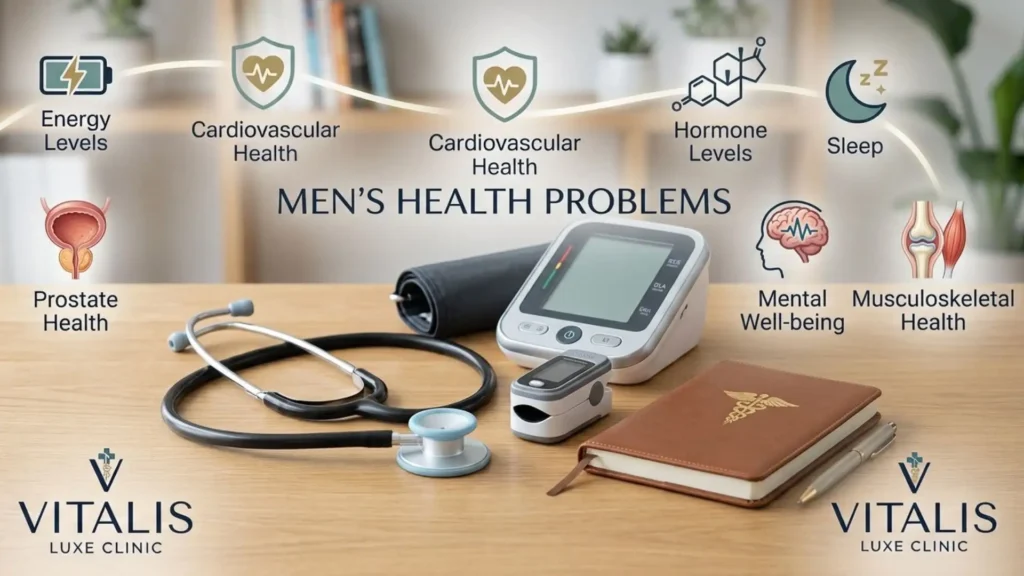

Men can experience changes in energy, sexual function, sleep, mood, weight, urinary health and general wellbeing at different stages of life. Some changes may be temporary, while others can persist, repeatedly return or begin to affect everyday life.
One of the challenges with men’s health is that many symptoms are not specific to a single condition. Persistent tiredness does not automatically mean low testosterone, reduced libido can have several possible causes, and erectile difficulties can sometimes relate to wider physical or psychological health.
Recognising changes and knowing when to seek professional advice can help identify whether further assessment is appropriate. If you are unsure about the range of concerns that may be discussed in a specialist setting, read our guide to what a men’s health clinic treats.
Table of Contents
What Are Common Men’s Health Problems?
Men’s health covers physical, sexual, hormonal and psychological wellbeing, as well as preventive health.
Common concerns may include:
- persistent fatigue or reduced energy
- low libido
- erectile difficulties
- changes in sexual function
- possible hormone-related symptoms
- sleep problems
- stress, anxiety or low mood
- unexplained weight changes
- concerns about blood pressure or cardiovascular health
- urinary changes
- changes in general physical wellbeing
Experiencing one of these symptoms does not necessarily mean that you have a particular medical condition.
What matters is the wider pattern: how long the symptom has been present, whether it is getting worse, whether it keeps returning and whether it is affecting your normal activities or quality of life.
Persistent Fatigue and Low Energy
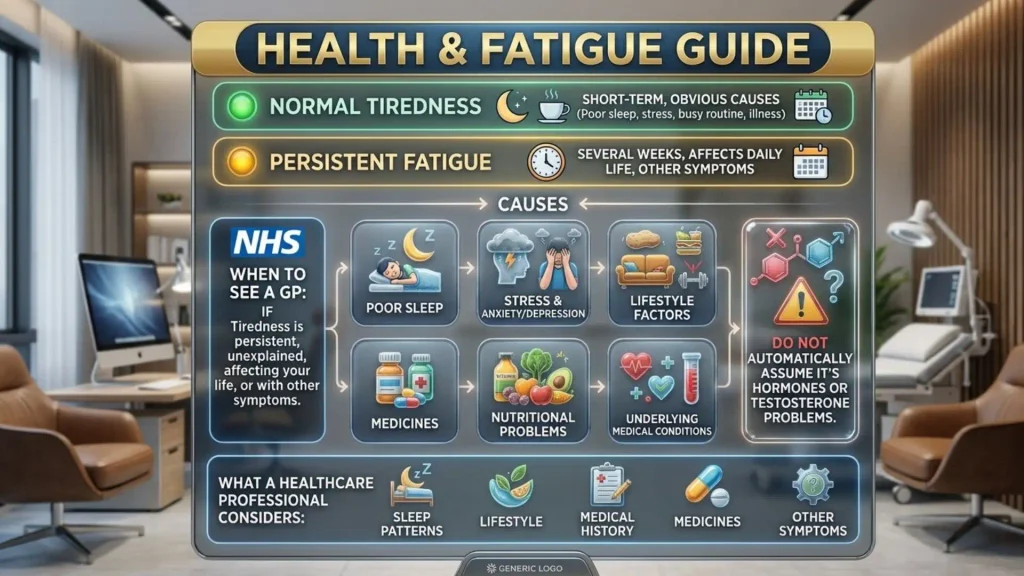
Feeling tired occasionally is normal. Poor sleep, stress, a busy routine or a short-term illness can all reduce energy temporarily.
Persistent or unexplained fatigue deserves more attention.
The NHS advises speaking to a GP if tiredness has continued for several weeks without an obvious explanation, is affecting daily life or occurs alongside other symptoms.
Fatigue can have many possible causes, including:
- poor sleep
- stress
- anxiety or depression
- lifestyle factors
- medicines
- nutritional problems
- underlying medical conditions
For this reason, ongoing tiredness should not automatically be interpreted as a hormone or testosterone problem.
A healthcare professional may consider the symptom alongside sleep, lifestyle, medical history, medicines and any other changes you have noticed before deciding whether further investigation is needed.
Read NHS guidance on tiredness and fatigue
Changes in Libido and Sexual Health
Sex drive naturally varies from person to person and can also change over time.
A temporary reduction in libido may happen during periods of stress, tiredness, illness or relationship difficulty. However, a persistent or unexplained change may be worth discussing with a healthcare professional.
The NHS identifies several factors that may contribute to low libido, including:
- stress
- anxiety
- depression
- relationship difficulties
- sexual problems
- certain medicines
- alcohol
- some long-term health conditions
- hormonal changes
Hormones can therefore be relevant, but low libido does not automatically mean low testosterone.
A proper assessment considers sexual-health symptoms alongside medical history, psychological wellbeing, medicines, lifestyle and other health concerns.
Read NHS guidance on loss of libido
Erectile Difficulties
Difficulty getting or maintaining an erection can happen occasionally and does not always indicate an underlying health problem.
Temporary erection difficulties may occur because of tiredness, stress or alcohol.
However, when erectile difficulties continue or repeatedly return, further assessment may be appropriate.
According to the NHS, persistent erectile dysfunction can sometimes be associated with conditions or factors including:
- high blood pressure
- high cholesterol
- diabetes
- anxiety
- depression
- hormone problems
- certain medicines
This is why erectile dysfunction can sometimes provide useful information about wider health rather than being viewed only as a sexual-performance issue.
An assessment may consider when the problem started, how frequently it occurs, libido, medicines, cardiovascular health, diabetes risk, psychological wellbeing and other symptoms.
Read NHS guidance on erectile dysfunction
Possible Hormone-Related Symptoms
Men sometimes associate symptoms such as tiredness, reduced libido, changes in mood or reduced physical performance directly with testosterone.
However, these symptoms can overlap with many other health concerns.
The NHS explains that symptoms sometimes associated with the so-called “male menopause” may also be related to lifestyle factors, stress, anxiety, depression or other health problems.
Late-onset hypogonadism is a specific medical condition and should not be assumed simply because a man is ageing or experiencing non-specific symptoms.
The appropriate pathway is generally:
symptoms → assessment → appropriate testing where indicated → clinical interpretation → next steps
rather than:
symptoms → assumed low testosterone → treatment
Where hormone testing is clinically appropriate, results need to be considered alongside symptoms and the wider clinical picture.
Read NHS information about late-onset hypogonadism and the “male menopause”
Sleep Problems
Sleep has an important relationship with physical and mental wellbeing.
Poor-quality sleep can affect:
- energy
- concentration
- mood
- exercise performance
- appetite
- libido
- general wellbeing
An occasional poor night’s sleep is common. Persistent sleep problems, however, can begin to affect daytime functioning.
Fatigue may sometimes occur alongside sleep disorders such as sleep apnoea. Symptoms can include excessive daytime tiredness together with loud snoring, gasping, choking or pauses in breathing during sleep.
If sleep problems persist or are affecting everyday life, further assessment may be appropriate.
Stress, Anxiety and Mental Wellbeing
Men’s health is not limited to physical symptoms.
Stress, anxiety, depression and other changes in mental wellbeing can influence many areas of health, including:
- sleep
- motivation
- energy
- concentration
- appetite
- libido
- erectile function
- physical activity
- overall quality of life
Some men may initially seek help for physical symptoms without realising that psychological or emotional factors may also be contributing.
For example, stress and anxiety can affect both libido and erectile function.
The reverse can also happen. Persistent sexual-health or physical-health problems may affect confidence, relationships and mental wellbeing.
Discussing these concerns openly can provide a more complete picture of your health.
For urgent mental-health support, NHS guidance explains how to access urgent help through NHS 111, while emergencies involving immediate danger require 999 or A&E.
Read NHS guidance on urgent mental-health help
Changes in Weight and General Wellbeing
Weight can change because of changes in diet, physical activity, stress, illness or other lifestyle factors.
However, unexplained weight loss or gain may sometimes justify further investigation, particularly if it occurs alongside other symptoms.
Changes worth discussing may include:
- unexpected weight loss
- significant unexplained weight gain
- reduced appetite
- persistent fatigue
- changes in thirst
- urinary changes
- changes in mood
- a general sense that your health has changed
The important distinction is whether the change has an obvious explanation.
If you have not intentionally changed your diet or physical activity but your weight or general wellbeing is changing significantly, seeking advice may help identify whether further assessment is needed.
Blood Pressure and Cardiovascular Health
Some important health problems can develop without obvious symptoms.
High blood pressure is one example. Many people do not know they have it until it is measured.
Cardiovascular health can also be relevant when investigating other men’s health concerns.
Persistent erectile dysfunction, for example, can sometimes occur alongside:
- high blood pressure
- high cholesterol
- diabetes
- other cardiovascular risk factors
Depending on your age, medical history and risk factors, a healthcare professional may consider measurements or investigations such as blood pressure, weight, cholesterol or blood glucose.
Not every man requires every test. Assessment should determine which checks are relevant.
Urinary Changes
Urinary symptoms become more common as men get older, but they should not automatically be dismissed as part of ageing.
Changes may include:
- urinating more frequently
- waking several times during the night to urinate
- difficulty starting urination
- a weak urine stream
- stopping and starting
- feeling that the bladder has not emptied fully
- dribbling afterwards
An enlarged prostate is one possible cause, particularly in older men, but urinary symptoms can occur for other reasons.
The NHS advises seeking medical advice for symptoms such as difficulty urinating or increased urinary frequency.
Some urinary symptoms require more urgent attention, including being unable to pass urine.
Read NHS guidance on enlarged prostate symptoms
Why Men’s Health Symptoms Should Be Considered Together
One symptom rarely tells the whole story.
For example:
Fatigue may be associated with sleep, stress, medicines, lifestyle or an underlying medical condition.
Low libido may involve psychological, relationship, medication, medical or hormonal factors.
Erectile difficulties may involve stress, cardiovascular health, diabetes, medicines or hormone-related concerns.
Looking at these symptoms together with medical history provides more useful information than treating one symptom in isolation.
A more appropriate clinical sequence is:
change in health → assessment → possible causes → relevant investigation → appropriate next step
This reduces the risk of assuming a diagnosis too early.
When Should You Seek Help for a Men’s Health Problem?
You do not necessarily need to wait until symptoms become severe before asking for medical advice.
Consider seeking professional assessment when:
- a symptom has continued for several weeks
- the problem repeatedly returns
- symptoms are gradually becoming worse
- there has been a clear change from your normal health
- the problem is affecting daily activities
- sexual-health concerns are persistent
- energy or sleep has significantly changed
- several unexplained symptoms have appeared together
- you have noticed new urinary problems
- you are concerned about possible hormone-related symptoms
- symptoms started after beginning or changing medication
- you are worried and do not understand what may be causing the change
Seeking help does not mean that something serious is necessarily wrong.
The purpose of assessment is to understand what has changed and decide whether reassurance, further investigation, monitoring or treatment may be appropriate.
Which Symptoms May Need Urgent Medical Attention?
Some symptoms should not wait for a routine men’s health appointment.
Chest Pain
Sudden or persistent chest pain or pressure can require emergency medical attention, particularly when accompanied by:
- breathlessness
- sweating
- feeling sick
- dizziness
- pain spreading to the arm, jaw, back or other areas
If a heart attack is suspected, call 999.
Read NHS guidance on chest pain
Possible Stroke Symptoms
The NHS recommends using FAST to recognise common stroke symptoms:
Face – facial weakness or drooping
Arms – weakness or numbness in one arm
Speech – slurred or confused speech
Time – call 999 immediately
Stroke symptoms require emergency medical attention even if they appear to improve.
Read NHS guidance on stroke symptoms
Severe Mental-Health Crisis
If someone’s life is at risk or they cannot keep themselves or another person safe, call 999 or go to A&E.
Urgent but non-emergency mental-health support may be available through NHS 111.
Read NHS guidance on urgent mental-health support
Being Unable to Urinate
An inability to pass urine can require urgent medical assessment.
Do not wait for a routine private appointment if you develop severe or rapidly worsening urinary symptoms.
If you are unsure whether symptoms require emergency care, NHS 111 can help direct you towards the appropriate service.
Read NHS guidance on when to call 999
What Happens When You Seek Professional Help?
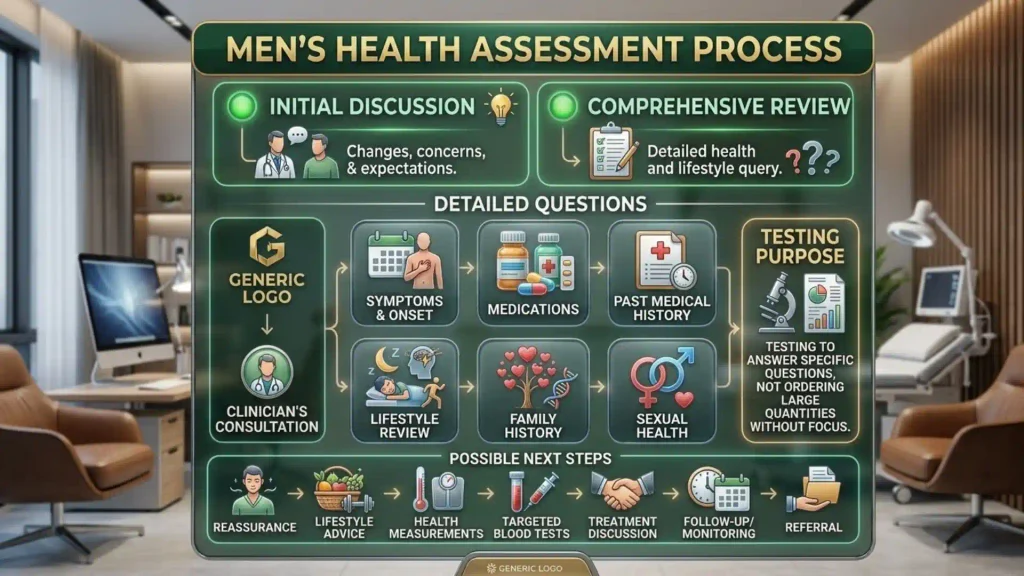
A men’s health assessment usually begins with a discussion about what has changed and why you are concerned.
You may be asked about:
- your symptoms
- when they started
- how frequently they occur
- whether they are changing
- medicines and supplements
- existing medical conditions
- previous investigations
- family medical history
- sleep
- stress
- exercise
- alcohol and smoking
- sexual health
- relevant previous test results
Depending on the concern, further assessment, basic health measurements or blood tests may then be considered.
Not every symptom requires blood testing.
The purpose of testing should be to answer a relevant clinical question rather than simply ordering a large number of tests without understanding what is being investigated.
Possible next steps may include:
- reassurance
- lifestyle advice
- health measurements
- targeted blood tests
- further clinical investigation
- monitoring
- follow-up
- treatment discussion
- referral to another healthcare professional where appropriate
You Do Not Need to Diagnose Yourself Before Asking for Help
It is common to notice that something has changed without knowing exactly why.
You may know that your energy has fallen but not understand the cause.
You may have noticed changes in libido without knowing whether hormones are involved.
You may be experiencing recurring erectile difficulties but be unsure whether physical health, stress, medicines or another factor is contributing.
You do not need to identify the diagnosis yourself.
Your role is to explain what you have noticed. A healthcare professional can then consider the symptoms in the context of your wider health and determine whether further investigation is appropriate.
Men’s Health Support at Vitalis Luxe Clinic
Vitalis Luxe Clinic provides private men’s health care from its clinic in Cottingham, near Hull, East Yorkshire.
Our approach starts with understanding your symptoms, medical history and individual circumstances rather than assuming that every concern requires the same test or treatment.
Depending on your needs, appropriate next steps may involve further assessment, relevant investigations, monitoring or discussion of treatment options.
Learn more about the consultations, assessments and services available through our Men’s Health Clinic.
Frequently Asked Questions
What are the most common men’s health problems?
Common concerns can include persistent fatigue, low libido, erectile difficulties, sleep problems, stress or mood changes, possible hormone-related symptoms, unexplained weight changes, urinary problems and cardiovascular risk factors.
When should a man seek medical advice about a health problem?
Consider seeking advice when a symptom persists, repeatedly returns, becomes worse, affects daily life or represents a noticeable change from your usual health. You can also seek professional advice whenever you are concerned and unsure about the cause.
Does feeling tired mean I have low testosterone?
No. Fatigue has many possible causes, including poor sleep, stress, medicines, lifestyle factors and underlying health conditions. Testosterone deficiency is only one possible consideration and requires appropriate clinical assessment.
Is low libido always caused by low testosterone?
No. Low libido may be influenced by psychological wellbeing, relationships, medicines, alcohol, sexual problems, medical conditions and hormonal factors.
When should erectile dysfunction be checked?
If erection problems repeatedly occur rather than happening occasionally, medical advice may be appropriate. Persistent erectile dysfunction can sometimes be associated with cardiovascular, metabolic, psychological or hormonal factors.
Are urinary problems simply part of getting older?
Not necessarily. Urinary symptoms become more common with age, but persistent changes should still be assessed because several conditions can affect urinary function.
Do common men’s health problems always require blood tests?
No. Testing depends on the symptoms, medical history and clinical question being investigated. Some concerns may require blood tests, while others may need a different form of assessment.
What men’s health symptoms require emergency care?
Possible heart-attack or stroke symptoms require emergency medical attention. Severe mental-health crises and certain acute urinary problems can also require urgent care. Call 999 for a life-threatening emergency.