
Cheek Filler Treatment in Hull, UK
At Vitalis Luxe Clinic, cheek filler is one of the treatment areas available within our wider dermal filler treatment options. Our clinic is based in Cottingham, near Hull, East Yorkshire. Book your consultation today to discuss whether cheek filler may be suitable for you.
Book an Appointment
What Are Cheek Fillers?
Cheek fillers are a type of dermal filler injected into selected areas of the cheeks or mid-face to add volume, enhance shape and create greater definition.
Many dermal fillers used for facial aesthetic treatment contain hyaluronic acid, a substance commonly used in injectable filler products to provide volume beneath the skin. UK government guidance describes cosmetic fillers as injectable gels and notes that hyaluronic acid is commonly used in these products.
The amount, placement and technique used should be determined according to your facial anatomy and the result you are hoping to achieve.
If you would like to understand the wider range of facial filler treatments available, visit our Dermal Fillers service page.
What Can Cheek Filler Improve?
Cheek filler may help restore volume that has reduced over time, particularly through the mid-face. This can be useful for people who feel their cheeks have become flatter, less full or less defined as facial volume changes with age.
It can also be used to enhance cheekbone definition and projection. Carefully planned filler placement may help create clearer contours and improve the structure of the cheeks without making the face look overly filled.
Cheek filler may also support overall facial balance by improving the relationship between the cheeks and surrounding features. The exact result depends on your natural anatomy, existing facial proportions and treatment goals, which is why consultation and assessment are important before treatment.
Cheek Filler for Lost Volume
Facial volume can change over time as part of the natural ageing process.
When volume reduces through the mid-face, the cheeks may appear flatter or less defined than previously.
Carefully placed filler may be used to restore volume in selected areas of the cheek and create a fuller, more supported appearance.
The objective should be a result that remains proportionate to the rest of the face rather than simply adding as much volume as possible.
Cheek Filler for Cheekbone Definition
Cheek filler can also be used where the goal is greater cheekbone definition rather than replacing lost volume.
Strategic placement may help:
- enhance cheekbone projection
- create clearer facial contours
- improve balance between the mid-face and surrounding features
- support a more structured cheek appearance
- address differences in facial symmetry where appropriate
The appropriate placement varies between patients because cheek shape, bone structure and facial proportions are different for everyone.
What Areas of the Cheeks Can Be Treated?
“Cheek filler” does not necessarily mean injecting the same point in every patient.
The cheeks form part of the wider mid-face, and treatment planning may consider different areas depending on your anatomy.
For example, one person may want more projection around the cheekbones, while another may be concerned about volume loss through the central cheek.
A consultation allows the practitioner to assess your facial structure and determine whether filler is appropriate, where it may be placed and how much may be suitable.
Can Cheek Filler Lift the Face?
Cheek filler is sometimes described online as a treatment that can “lift” the face.
Adding support or volume to the mid-face may influence how surrounding facial areas appear, but cheek filler should not be presented as a guaranteed substitute for a surgical lifting procedure.
The effect depends on facial anatomy, existing volume, skin characteristics and the treatment plan.
Similarly, concerns such as under-eye hollowing, nasolabial folds or jowls should be assessed individually rather than assuming that cheek filler will automatically correct them.
Who May Be Suitable for Cheek Filler?
Cheek filler may be considered by adults who want to address concerns such as reduced cheek volume, limited cheekbone definition, changes in facial contour or imbalance through the mid-face.
Suitability cannot be determined from a photograph or one symptom alone.
Your consultation should consider your goals, facial anatomy, medical history, previous aesthetic treatments and any factors that could affect whether treatment is appropriate.
There may also be circumstances in which filler should be delayed or another treatment approach may be more suitable.
A professional consultation is therefore an important part of treatment planning.
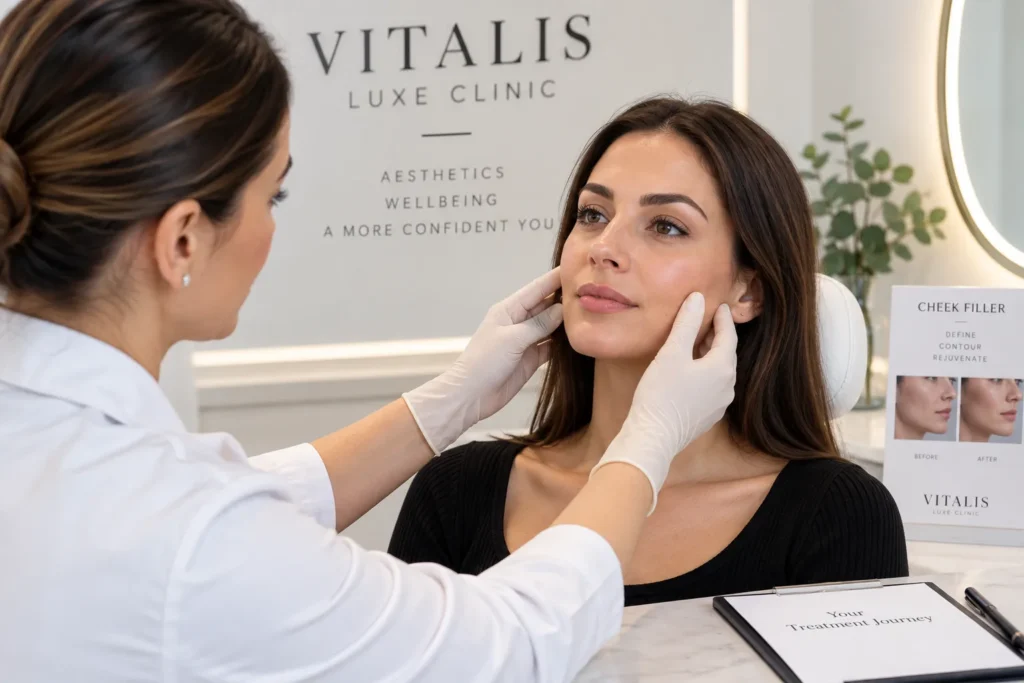
What Happens During a Cheek Filler Consultation?
Before treatment, you should have an opportunity to explain what you would like to change and what you expect from cheek filler.
The consultation may include an assessment of:
your facial proportions, existing cheek volume, cheekbone structure, symmetry, previous filler or aesthetic treatment, relevant medical history and your desired outcome.
The practitioner can then explain what cheek filler may realistically achieve, how much product may be considered and where treatment could be placed.
This is also the appropriate time to discuss possible side effects, risks, aftercare and alternatives before deciding whether to proceed.
Cheek Filler Before and After Results
Cheek filler before-and-after results can show changes in cheek volume, cheekbone definition and overall mid-face contour. The final appearance varies depending on your facial anatomy, treatment goals and the amount and placement of filler used. Genuine before-and-after photographs can help set realistic expectations and show the type of improvement that may be achieved.
Before Cheek Filler Treatment
Before cheek filler treatment, some people may notice reduced volume through the cheeks or mid-face.
The cheekbones may appear less defined, and the overall facial contour can look softer or flatter. These concerns can develop naturally or become more noticeable with age.
During the consultation, the practitioner assesses cheek structure, facial proportions and symmetry. This helps identify where volume may be lacking and whether cheek filler is suitable for the result you want. Your previous aesthetic treatments and medical history may also be discussed.
The treatment plan should be based on your individual facial anatomy rather than a standard amount of filler. The aim is to understand the changes you want to make while maintaining balance with the rest of your facial features.
After Cheek Filler Treatment
After cheek filler treatment, the cheeks may appear fuller, more defined or better contoured depending on the areas treated. Cheekbone projection may become more noticeable, while improved mid-face volume can create a more structured appearance.
Some results may be visible shortly after treatment, although temporary swelling or tenderness can affect the initial appearance. The treated area may continue to settle as these early effects reduce over the following days.
Final results vary from person to person and depend on facial anatomy, filler placement and the amount used. Before-and-after photographs of genuine Vitalis Luxe Clinic patients can help demonstrate realistic treatment outcomes where appropriate consent has been obtained.
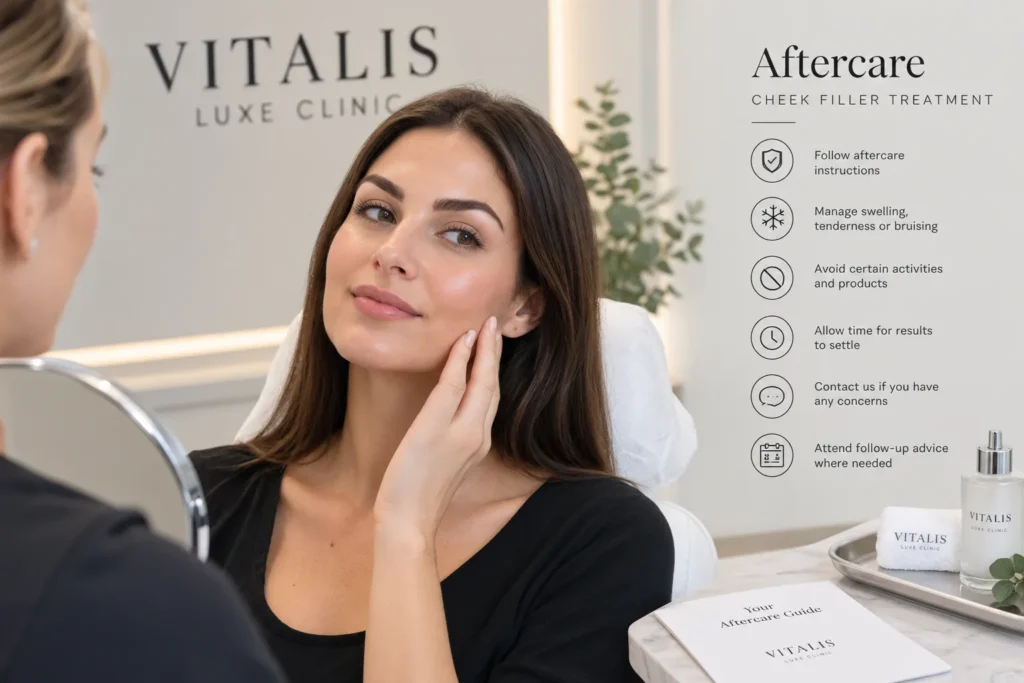
Cheek Filler Aftercare and Recovery
Aftercare instructions should be based on the treatment you have received and the advice provided by your practitioner.
You may experience temporary swelling, tenderness, redness or bruising around injection points.
Follow the clinic’s aftercare guidance and contact the practitioner if something does not feel right or you develop symptoms that concern you.
Do not rely on generic social-media advice where it conflicts with instructions given by your treating healthcare professional.
As your topical cluster grows, detailed recovery information can move into a dedicated Cheek Filler Aftercare article, while this service page retains the essential summary.
What Cheek Filler Cannot Guarantee
Cheek filler can change volume and contour, but it cannot guarantee a particular face shape or make you look identical to another person’s before-and-after photograph.
It also cannot reliably correct every concern involving the lower face, under-eye area or skin laxity.
A good treatment plan should begin with the concern you want to address and then determine whether cheek filler is actually the appropriate treatment.
In some cases, another treatment or no treatment may be more suitable.
Cheek Filler Side Effects and Risks
Dermal filler is a medical aesthetic procedure and is not risk-free.
Temporary effects around the injection area can occur, while less common complications can be more serious.
This is one reason the qualifications, training and experience of the person performing the treatment matter.
The NHS specifically advises people considering dermal fillers to ask what product will be used, where it came from and what qualifications, training and experience the practitioner has. It also notes that filler complications can include serious outcomes such as infection, nerve damage and blindness.
Your practitioner should explain the relevant risks, what signs to look out for after treatment and what to do if you are concerned.
How Long Does Cheek Filler Last?
Cheek filler results are temporary.
How long they remain visible can vary depending on the filler product used, the amount and placement of filler, individual metabolism and other personal factors.
The appearance may also change gradually as the filler breaks down over time.
During consultation, your practitioner can explain what duration may reasonably be expected from the specific product and treatment plan being considered.
Avoid promising an exact duration for every patient.

Our Founder
Dr. Naveed Shaikh - MBBS (Newcastle upon Tyne) MRCGP
Dr Naveed Shaikh is the founder of Vitalis Luxe Clinic and holds MBBS (Newcastle upon Tyne) and MRCGP qualifications. His medical background supports a consultation-led approach across men’s health and aesthetic care, with treatment decisions based on individual concerns, medical history, suitability and realistic goals.
Dr Naveed also sees patients at Optima Clinic in Hull, where consultations and selected treatments can be provided within a professional clinical setting.
Vitalis Luxe Clinic operates as Dr Naveed’s independent practice, providing personalised men’s health and aesthetic care. Where Optima Clinic is used as a consultation or treatment venue, Vitalis Luxe Clinic remains a separate independent service.
Why Choose Vitalis Luxe Clinic for Cheek Filler?
Vitalis Luxe Clinic provides aesthetic treatments in Cottingham, near Hull, East Yorkshire. Our cheek filler treatments focus on facial balance, suitable product placement and results that complement your natural features.
- Personalised cheek filler consultation
- Facial assessment based on your features and treatment goals
- Treatment planning focused on facial balance
- Filler placement tailored to the areas that need volume or definition
- Clear guidance on expected results, risks and aftercare
Vitalis Luxe Clinic provides cheek filler treatment in Cottingham, near Hull, East Yorkshire. Each treatment begins with a consultation to assess your facial structure, discuss your concerns and plan an approach that suits your individual features.
Frequently Asked Questions About Cheek Filler
What is cheek filler?
Cheek filler is an injectable dermal filler treatment used to add or restore volume in selected areas of the cheeks and mid-face. It may also be used to enhance cheekbone definition and facial contour.
What does cheek filler do?
Depending on treatment goals and anatomy, cheek filler may restore lost volume, enhance cheekbone projection or improve contour and definition through the mid-face.
How much cheek filler do I need?
There is no standard amount for everyone. The appropriate quantity depends on your anatomy, existing volume, treatment area and desired outcome.
How long does cheek filler last?
Cheek filler is temporary. Longevity varies according to the product, amount, placement and individual factors such as metabolism.
Are cheek fillers painful?
People experience treatment differently. Some pressure or discomfort may be felt during injection, and comfort measures may be used depending on the treatment and product.
Is cheek filler safe?
Dermal fillers carry risks as well as potential benefits. A consultation with an appropriately trained practitioner should include discussion of suitability, the product being used, potential side effects, complications and aftercare.
How long does cheek filler take to settle?
The treated area may initially look different because of temporary swelling or tenderness. The final appearance is better assessed after early treatment effects have settled.
Can cheek filler improve jowls or nasolabial folds?
Changes in mid-face volume can sometimes influence the appearance of neighbouring areas, but cheek filler should not be presented as a guaranteed treatment for jowls or nasolabial folds. These concerns should be assessed individually.
When Will You See the Final Result?
Neither is universally better. Polynucleotides primarily target skin quality, while Botox targets selected muscle activity. The right treatment depends on what you want to improve.
What does 1ml of cheek filler look like?
The appearance of 1ml of cheek filler varies from person to person because facial size, cheek structure, existing volume and filler placement are different. One millilitre may create a subtle change in one patient and a more noticeable result in another, so the amount should be chosen following facial assessment rather than based on photographs alone.
Book a Cheek Filler Consultation
If you are considering cheek filler and would like to understand which approach may suit your facial structure and aesthetic goals, book a consultation with Vitalis Luxe Clinic.
Your consultation provides an opportunity to discuss the areas you would like to improve, ask questions and understand the treatment plan before making a decision.