

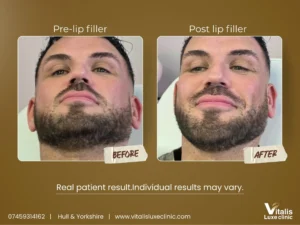





Botox and fillers or Dermal Fillers are two popular non-surgical aesthetic treatments, but they are designed for different concerns.
Botox is generally used for facial lines linked to repeated muscle movement, while dermal fillers are used to add or restore volume, improve shape and support selected facial contours.
So, when comparing Botox vs fillers, there is no single treatment that is better for everyone. Botox may be more appropriate for one concern, while dermal filler may be more suitable for another.
The right treatment depends on what you want to improve, your facial anatomy and the cause of the concern.
At Vitalis Luxe Clinic, both Botox treatment and dermal filler treatment at our aesthetic clinic in Cottingham, near Hull, East Yorkshire. Book a consultation to discuss which treatment may be more suitable for your aesthetic goals.
Table of Contents
What Is the Difference Between Botox and Fillers?
The main difference between Botox and dermal fillers is how they work.
Botox temporarily reduces activity in selected muscles. This can help soften facial lines that become more noticeable when you frown, raise your eyebrows, smile or squint.
Dermal fillers work differently. They are injectable products placed beneath the skin to add or restore volume, improve definition and provide support in selected areas.
In simple terms:
| Botox | Dermal Fillers |
|---|---|
| Targets selected muscle activity | Adds or restores volume |
| Commonly used for movement-related lines | Commonly used for volume, shape and contour |
| Does not add physical volume | Adds volume beneath the skin |
| Results develop gradually | Changes may be visible sooner |
| Often used for forehead, frown and eye-area lines | Often used for lips, cheeks, chin and other selected areas |
Botox and fillers therefore should not be treated as interchangeable procedures.
What Is Botox?
Botox is a widely recognised brand associated with botulinum toxin treatment.
Botulinum toxin works by temporarily reducing nerve signals to selected muscles. When muscle activity is reduced, some expression-related facial lines can appear softer.
In the UK, botulinum toxin products are prescription-only medicines. The Medicines and Healthcare products Regulatory Agency explains that botulinum toxin products should be prescribed and used appropriately because they are regulated medicines rather than ordinary cosmetic products.
This makes proper assessment and prescribing an important part of treatment.
What Is Botox Commonly Used For?
Botox may be considered for selected movement-related concerns such as:
- forehead lines
- frown lines between the eyebrows
- lines around the outer eye area
- selected expression-related facial lines
Botox does not physically fill a wrinkle or add volume.
Its effect comes from temporarily reducing activity in selected facial muscles.
What Are Dermal Fillers?
Dermal fillers are injectable treatments used to add or restore volume beneath the skin.
Many temporary dermal fillers contain hyaluronic acid. Depending on the treatment area and patient anatomy, filler may be used to improve volume, definition, support or facial balance.
Unlike Botox, fillers do not primarily work by affecting muscle movement.
Their purpose is more closely related to volume and facial structure.
What Can Dermal Fillers Be Used For?
Depending on the patient and treatment area, fillers may be considered for:
- lip volume and definition
- cheek volume
- chin shape and projection
- facial balance
- selected deeper lines
- areas affected by volume loss
The FDA guidance on dermal fillers also explains that dermal fillers can be used for selected facial volume and contour concerns, although treatment regulations and product approvals differ between countries.
For UK patients, local UK clinical and regulatory guidance should remain the primary reference.
Botox vs Fillers: How Do They Work Differently?
Understanding how they work makes the comparison much easier.
Botox Targets Muscle Movement
Some facial lines become more noticeable because the same muscles contract repeatedly.
For example, when you:
- raise your eyebrows
- frown
- squint
- smile
specific muscles repeatedly move the skin.
Botox temporarily reduces activity in selected muscles, which can help soften certain movement-related lines.
Fillers Target Volume and Structure
Dermal fillers address a different type of concern.
Instead of affecting muscle activity, fillers introduce volume beneath the skin.
They may therefore be considered when the goal involves:
- restoring lost volume
- enhancing lip volume or shape
- improving chin definition
- supporting selected facial contours
The key question is not simply:
“Botox or fillers?”
It is:
“Is my concern mainly caused by muscle movement, or is it related to volume and structure?”
Botox or Fillers: Which Is Better for Wrinkles?
Neither treatment is automatically better for every wrinkle.
The right option depends on why the line has developed.
Dynamic or Movement-Related Lines
Dynamic lines appear or become more noticeable when facial muscles move.
These may include lines that become visible when you:
- frown
- raise your eyebrows
- smile
- squint
Where repeated muscle activity is the main cause, Botox may be more appropriate.
Static Lines and Volume-Related Concerns
Static lines remain visible even when the face is relaxed.
They can be influenced by:
- ageing
- skin quality
- reduced facial volume
- structural changes
- repeated movement over time
In selected cases, dermal fillers may be considered when volume loss or structural support is contributing to the concern.
However, not every static line requires filler, which is why assessment is important before treatment.
Botox vs Fillers by Treatment Area
Different treatment areas often require different approaches.
Forehead and Frown Lines
Where forehead or frown lines are mainly associated with repeated facial movement, Botox may be considered.
This is a muscle-related concern rather than a volume concern.
Lips
Where the aim is to improve lip volume, definition or selected aspects of lip shape, dermal filler is generally the more relevant treatment.
Cheeks
Dermal filler may be considered when additional or restored cheek volume is appropriate.
Treatment should consider overall facial proportions rather than treating one area in isolation.
Chin
Dermal filler may also be used in suitable patients where the goal is to improve chin shape, projection or facial balance.
Other Facial Lines
Some facial lines have several contributing causes.
Muscle movement, skin quality, ageing and volume changes may all play a role.
This is why the correct treatment should be selected according to the underlying cause rather than simply the location of the line.
Botox vs Fillers: How Quickly Do Results Appear?
Botox and fillers also differ in how their results develop.
Botox Results
Botox does not normally produce its full effect immediately.
The result develops gradually as activity in the selected muscles begins to reduce.
Patients should allow appropriate time before assessing the final effect.
Dermal Filler Results
Dermal filler can often produce visible changes sooner because volume has physically been introduced into the treated area.
However, the early appearance can be affected by:
- swelling
- redness
- tenderness
- bruising
The more settled result should therefore be assessed after these temporary effects have reduced.
How Long Do Botox and Fillers Last?
Both treatments are temporary.
Botox effects commonly last for several months, although this varies between individuals.
Dermal filler longevity can vary depending on factors such as:
- treatment area
- type of filler
- amount used
- facial movement
- metabolism
- individual response
These timeframes should be treated as general guidance rather than guarantees.
Can Botox and Fillers Be Used Together?
Yes, Botox and dermal fillers may sometimes be used within the same overall treatment plan.
This is because they address different concerns.
For example, a person may have movement-related lines in one area and a separate concern involving volume or facial contour in another.
Botox may be considered for the movement-related concern, while filler may be used for the volume-related concern.
However, combining treatments should not simply mean using more product.
The purpose should be to address specific concerns while maintaining facial balance.
Botox vs Fillers: Which Gives More Natural Results?
Natural results depend on factors such as:
Both treatments can produce subtle and natural-looking results when they are appropriately selected and carefully planned.
- facial anatomy
- treatment area
- treatment goal
- amount used
- technique
- existing facial proportions
- realistic expectations
The treatment should work with the patient’s existing features rather than changing them unnecessarily.
Choosing the right treatment for the right concern is often more important than choosing Botox or fillers based on popularity.
Are Botox and Fillers Safe?
Botox and dermal fillers are established aesthetic procedures, but no injectable treatment should be considered completely risk-free.
The NHS guidance on cosmetic procedures recommends researching the procedure, understanding the possible risks and choosing an appropriately trained and experienced practitioner before proceeding with cosmetic treatment.
The risks associated with Botox and fillers are also different because the treatments work differently.
Is Botox Safe?
Botulinum toxin is a prescription-only medicine in the UK.
The NHS guidance on choosing a cosmetic practitioner advises patients to understand who is prescribing the treatment, who will administer it and what training and experience the practitioner has.
Possible temporary effects after Botox injections can include:
- redness
- bruising
- tenderness
- swelling around the injection area
There are also uncommon but potentially serious complications.
The MHRA’s updated botulinum toxin safety guidance warns about rare cases in which the effects of botulinum toxin may spread beyond the injection area.
Symptoms such as difficulty swallowing, breathing problems, unusual muscle weakness or speech changes require urgent medical attention.
The MHRA also advises patients to ensure that authorised products are being used and that treatment is provided appropriately.
Are Dermal Fillers Safe?
Dermal fillers also have recognised side effects and potential complications.
Common temporary effects can include:
- swelling
- redness
- bruising
- tenderness
- discomfort
The NHS advice on choosing a practitioner also recommends checking the practitioner’s training and experience and asking what product will be used before having dermal filler treatment.
One uncommon but important risk is accidental injection of filler into a blood vessel.
The FDA’s dermal filler safety guidance describes unintended injection into a blood vessel as one of the most serious potential complications associated with fillers.
This can interrupt blood supply and, in rare cases, lead to serious tissue or visual complications.
This is one reason dermal filler treatment should be approached as a clinical aesthetic procedure rather than a simple beauty treatment.
How Can You Reduce the Risks of Botox or Fillers?
No practitioner can make an injectable treatment completely risk-free, but patients can take sensible steps before proceeding.
The NHS recommends researching cosmetic treatments and practitioners and understanding both the expected benefits and potential complications.
Before treatment, useful questions include:
- Who will perform my consultation?
- Who will prescribe my Botox treatment?
- Who will carry out the injections?
- What training and experience does the practitioner have?
- What product will be used?
- What side effects should I expect?
- What serious complications should I know about?
- What happens if I experience a problem?
- What aftercare is provided?
For Botox, patients should also be cautious about unlicensed or counterfeit products.
The MHRA has warned about illegal or unauthorised botulinum toxin products, reinforcing the importance of checking the practitioner and product before treatment.
Botox vs Fillers for Different Aesthetic Goals
A simple way to compare Botox and fillers is to start with the result you want.
If You Want to Soften Expression Lines
Botox may be more relevant where repeated muscle movement is the main cause.
If You Want to Add or Restore Volume
Dermal fillers are generally more relevant when the goal is to add or restore volume.
If You Want More Shape or Definition
Filler may be considered for selected areas where the aim involves shape, definition or facial balance.
If You Have More Than One Concern
Some patients have both movement-related and volume-related concerns.
In appropriate cases, Botox and fillers may both be considered as part of a wider treatment plan.
Botox or Fillers: Which One Is Right for Me?
The most appropriate treatment depends on the cause of the concern rather than which treatment is more popular.
A simple guide is:
Movement-related facial lines → Botox may be considered.
Volume, shape or contour concerns → Dermal filler may be considered.
Different concerns in different areas → More than one treatment approach may sometimes be appropriate.
However, patients should not feel they need to diagnose themselves.
A consultation can assess:
- facial anatomy
- facial movement
- existing volume
- treatment area
- facial proportions
- medical history
- previous treatments
- treatment expectations
- suitability for injectable procedures
The most suitable option may be Botox, dermal filler, a combination approach or another treatment entirely.
Botox and Dermal Fillers at Vitalis Luxe Clinic
Vitalis Luxe Clinic provides aesthetic treatments from our clinic in Cottingham, near Hull, East Yorkshire.
Our approach begins by understanding what the patient wants to improve rather than automatically recommending one particular injectable treatment.
Where muscle movement is the main concern, Botox may be considered.
Where volume, shape or facial contour is the main concern, dermal filler may be more suitable.
Botox vs Fillers: Final Comparison
Botox and dermal fillers are both injectable aesthetic treatments, but they serve different purposes.
Botox temporarily reduces activity in selected muscles and is commonly considered for movement-related facial lines.
Dermal fillers add or restore volume and may be considered for concerns involving shape, support and facial contour.
Neither treatment is universally better.
The right choice depends on the treatment area, facial anatomy, cause of the concern and the patient’s goals.
Because both treatments have possible side effects and complications, an appropriate consultation with a suitably trained practitioner is important before proceeding.
Frequently Asked Questions
What is the main difference between Botox and fillers?
Botox temporarily reduces activity in selected muscles, while dermal fillers add or restore volume beneath the skin. They therefore address different types of aesthetic concerns.
Is Botox or filler better for wrinkles?
It depends on what is causing the wrinkle. Botox may be more relevant for movement-related lines, while dermal filler may sometimes be considered where volume loss or structural changes contribute to the concern.
Is Botox or filler better for lips?
Dermal filler is generally the relevant treatment where the goal is to increase lip volume, improve definition or enhance shape.
Can Botox and fillers be used together?
Yes. They may sometimes be used in the same overall treatment plan because they address different aesthetic concerns.
Which lasts longer, Botox or fillers?
There is no universal answer. Botox commonly lasts several months, while dermal filler longevity varies according to the treatment area, product, amount used and individual response.
Are Botox and fillers safe?
Both are established aesthetic treatments but have potential side effects and complications. The NHS advises patients considering cosmetic procedures to understand the risks and choose an appropriately trained and experienced practitioner.
Can dermal fillers cause serious complications?
Serious complications are uncommon but possible. The FDA’s dermal filler guidance explains that accidental injection into a blood vessel can cause serious complications, which is why appropriate training and anatomical knowledge are important.
How do I know whether I need Botox or fillers?
The answer depends on what is causing your concern. Movement-related lines may be more suited to Botox, while volume, shape and contour concerns may be more suited to dermal fillers. A consultation can help determine the appropriate treatment.
Book an Aesthetic Consultation at Vitalis Luxe Clinic
If you are considering Botox or dermal fillers and are unsure which option may suit your concern, Vitalis Luxe Clinic can discuss your aesthetic goals and treatment options.
Our clinic is based in Cottingham, near Hull, East Yorkshire. Book a consultation to discuss an individual treatment approach based on your needs.