





Anti-wrinkle injections are the most commonly performed non-surgical cosmetic procedure in the UK — and for good reason. When administered correctly by a trained clinician, they offer a predictable, reversible, and remarkably effective way to soften facial lines and prevent their further deepening, without the recovery time or permanence of surgery.
At Vitalis Luxe Clinic, we perform Botox or anti-wrinkle injections as part of a broader aesthetic using licensed botulinum toxin products administered by clinicians who understand both facial anatomy and the specific requirements of each patient. This article explains what anti-wrinkle injections are, how they work at a biological level, which areas respond best, what to expect during and after treatment, and how to distinguish results that represent good clinical work from those that do not.
Whether you are considering treatment for the first time or exploring a new provider in Hull or across Yorkshire, this guide gives you the clinical context to make an informed decision.
Table of Contents
What Are Anti-Wrinkle Injections? The Science Behind the Treatment
Anti-wrinkle injections use botulinum toxin type A — a purified protein produced by the bacterium Clostridium botulinum — to temporarily block the nerve signals that cause specific facial muscles to contract. When a targeted muscle cannot contract, the overlying skin cannot crease, and the dynamic lines produced by that muscle’s repeated movement relax and soften.
The Mechanism at the Neuromuscular Junction
The neuromuscular junction is the point where a motor nerve terminal meets a muscle fibre. Normally, when a nerve fires, it releases acetylcholine — the neurotransmitter that crosses the junction and triggers muscle contraction. Botulinum toxin works by cleaving SNAP-25, a protein essential for the vesicle fusion that releases acetylcholine. Without acetylcholine release, the nerve signal cannot trigger muscle contraction.
This process is localised to the injected muscle — it does not affect sensation, circulation, or nearby untreated muscles. The toxin binds irreversibly to the nerve terminal, but the effect is temporary because the body generates new nerve terminal sprouts over approximately 3–4 months, re-establishing acetylcholine release and gradually restoring full muscle function. This is why anti-wrinkle injections require repeat treatment to maintain their effect — and why the effect is fully reversible if treatment is stopped.
Dynamic vs. Static Lines
It is important to understand the difference between dynamic lines and static lines, as this determines what anti-wrinkle injections can and cannot achieve:
- Dynamic lines — lines that appear when the face is in motion (frowning, raising the brows, smiling) and disappear or substantially reduce at rest. These respond excellently to anti-wrinkle injections — the muscle relaxation eliminates the movement that creates them
- Static lines — lines that are present at rest, even without facial movement. These are produced by collagen loss, skin thinning, and sun damage rather than muscle action alone. Anti-wrinkle injections can soften static lines by preventing further deepening, but cannot fully erase established static lines — dermal fillers or skin treatments are more appropriate for existing static lines
The most effective outcomes from anti-wrinkle injections occur when treatment begins before dynamic lines have fully transitioned to deep static lines — preventive treatment in the 20s and 30s, or early treatment in the 40s before lines are heavily etched, consistently produces superior long-term results to treating established deep lines.
Licensed Products Used at Vitalis Luxe Clinic
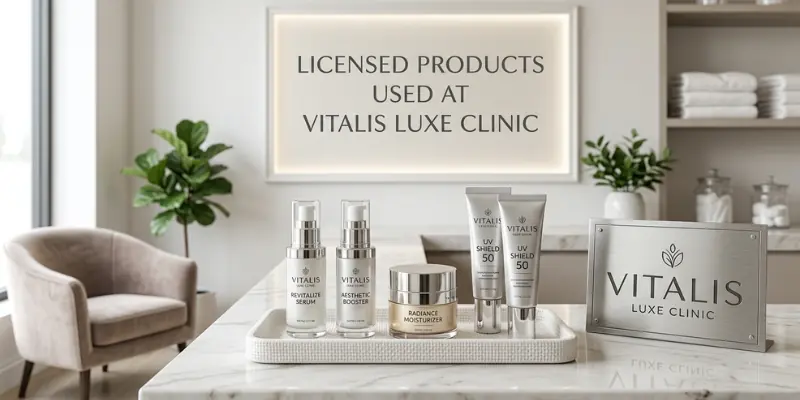
All anti-wrinkle injections at Vitalis Luxe Clinic use licensed botulinum toxin type A products. The major licensed brands in the UK are Botox (Allergan), Azzalure (Galderma), and Bocouture (Merz). All contain the same active ingredient — botulinum toxin type A — but differ in their unit measurement conventions and protein complexes. This means that unit doses are not directly interchangeable between products; an experienced clinician understands these differences and doses accordingly.
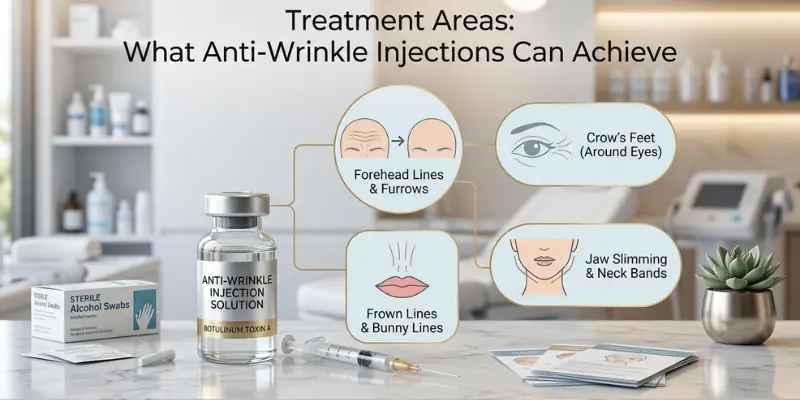
Treatment Areas: What Anti-Wrinkle Injections Can Achieve
Upper Face — The Primary Treatment Zone
The upper face — forehead, glabella (between the brows), and crow’s feet — is where anti-wrinkle injections deliver their most reliable and widely appreciated results. These three areas are almost always considered together, because the muscles involved interact and treating one without considering the others can produce imbalanced results.
- Forehead — horizontal lines created by repeated frontalis muscle action (raising the brows). Responds excellently to treatment; must be calibrated against brow position and always considered alongside glabellar treatment
- Glabella (’11 lines’, frown lines) — vertical lines between the brows created by corrugator and procerus muscles. Among the most impactful treatments — eliminating the resting ‘frown’ that makes people appear angry or unapproachable when they feel neither
- Crow’s feet — radiating lines at the outer eye corners created by orbicularis oculi during smiling and squinting. Natural-looking softening of these lines produces a rested, younger-appearing eye area; natural eye crinkles on genuine smiling should be preserved
Mid-Face and Additional Areas

- Bunny lines — diagonal lines on the nose bridge created by the nasalis muscle; often more visible after glabellar treatment and easily addressed with small additional doses
- Brow lifting — precise lateral placement above the brow tail can produce a subtle lifting effect, opening the eye and addressing early brow heaviness
- Lip lines — very fine doses around the lip border can soften vertical lip lines (‘smoker’s lines’); requires an extremely light touch as this area is highly expressive, and overdoing it impairs speech and movement
- Chin dimpling — small doses into the mentalis muscle can smooth a dimpled or cobblestone chin texture
- Neck bands (platysmal bands) — treatment of the vertical platysma muscle bands visible in the neck, contributing to a more defined neck and jawline contour (‘Nefertiti lift’ when combined with jawline treatment)
Medical Applications
- Hyperhidrosis (excessive sweating) — injections into axillae, palms, or soles block eccrine sweat gland acetylcholine signalling; dramatically effective for 6–12 months; one of the most life-changing applications for suitable patients
- Bruxism and TMJ — masseter and temporalis muscle treatment reduces jaw clenching force, headache from bruxism, and dental wear; also produces lower face slimming as a cosmetic benefit
- Chronic migraine — botulinum toxin is a licensed treatment for chronic migraine under specialist neurological care; aesthetic clinics do not manage this indication, but patients may wish to know it exists
Treatment Area | Lines/Condition Addressed | Typical Sessions Needed | Duration | Notes |
|---|---|---|---|---|
Forehead | Horizontal expression lines | 1 | 3–4 months | Always treated alongside glabella; brow height assessed first |
Glabella (11s) | Vertical frown/anger lines | 1 | 3–4 months | High patient satisfaction; stronger muscles need adequate dosing |
Crow’s feet | Lateral eye radiating lines | 1 | 3–4 months | Natural eye crinkle during smiling preserved |
Brow lift (lateral) | Brow heaviness; hooded eyes | 1 | 3–4 months | Subtle; preserve natural brow shape |
Bunny lines | Nose bridge diagonal lines | 1 (add-on) | 3–4 months | Often added when glabella treated |
Lip lines | Vertical peri-oral lines | 1 | 3 months | Very light dosing; affects movement — experience critical |
Chin dimpling | Cobblestone chin texture | 1 | 3–4 months | Addresses mentalis overactivity |
Neck bands | Platysma vertical bands | 1–2 | 3–4 months | Part of Nefertiti lift protocol |
Hyperhidrosis | Excessive sweating (underarms/palms) | 1 | 6–12 months | Highly effective; longer lasting than facial treatment |
Jaw width, grinding; jaw pain | Jaw width, grinding, jaw pain | 1–2 | 4–6 months | Cumulative volume reduction with repeat treatment |
Before Your Treatment: Preparation
- Avoid alcohol for 24 hours before your appointment — alcohol increases the risk
- Avoid aspirin and ibuprofen for 48 hours, where medically safe — these thin the blood and increase bruising
- Arrive with clean skin — no heavy creams, sunscreen, or makeup at the treatment sites
- Inform your clinician of any medications, particularly blood thinners, antidepressants, or muscle relaxants
- Inform your clinician of any previous botulinum toxin treatments and how you responded
- Do not have anti-wrinkle injections if pregnant, breastfeeding, or if you have a neuromuscular disease (myasthenia gravis, Lambert-Eaton syndrome)
During the Treatment: What Actually Happens
Your clinician will begin with a brief assessment — observing your facial movements and anatomy at rest and in expression, discussing your concerns and goals, and agreeing which areas to treat. No treatment proceeds without this clinical assessment and your informed consent.
Treatment itself typically takes 15–30 minutes for a standard upper face treatment. Very fine needles are used — most patients describe the sensation as a series of mild pinches. Topical anaesthetic cream is available for sensitive areas on request but is not usually necessary.
You will be asked to make specific expressions during the treatment to assist with muscle identification and injection placement. Small amounts of solution are injected at multiple points across the treated muscles — the number of injection points varies by area, muscle size, and the treatment plan agreed.
After the final injection, the appointment is complete. There is no recovery period — you can return to normal activities immediately, with a small number of post-treatment instructions to follow.
After Treatment: What to Do and What to Expect
Immediate Post-Treatment (First 24 Hours)
- Stay upright for at least 4 hours — do not lie flat or bend over for prolonged periods
- Do not rub or massage the treated areas — this can cause product migration to unintended muscles
- Avoid strenuous exercise, saunas, steam rooms, and excessive heat for 24 hours — increased circulation can affect product distribution
- Small bumps or redness at injection sites are normal — these typically resolve within a few hours
- Mild bruising is possible and resolves within 5–10 days; arnica gel or tablets may help
The First Two Weeks
Anti-wrinkle injections do not produce instant results. The botulinum toxin takes 3–5 days to begin blocking acetylcholine release at the treated nerve terminals, and the full effect develops over 10–14 days. Patients who judge their results at day 3 are assessing an incomplete treatment. The two-week mark is when the full effect is visible and any top-up or review is appropriate.
The Review Appointment
At Vitalis Luxe Clinic, a review appointment at two weeks is standard practice — particularly for new patients. This appointment allows assessment of the full treatment result, identification of any areas where the effect is uneven or incomplete, and any top-up where clinically indicated. Building a complete picture of how an individual patient responds to a specific dose is how personalised treatment is developed over successive appointments.
How Long Do Anti-Wrinkle Injections Last?
For most patients, anti-wrinkle injections last 3–4 months. The duration reflects the biological timeline of nerve terminal recovery — new acetylcholine-releasing sprouts gradually re-establish function, restoring muscle movement and line formation over this period. Several factors affect individual duration:
- Muscle mass and strength — stronger muscles (more common in men) may metabolise the effect slightly faster initially; regular treatment reduces muscle bulk over time and often extends duration
- Metabolism — higher metabolic rates (associated with high exercise frequency, thyroid activity, and younger age) may shorten duration
- Dose — appropriately dosed treatment lasts longer than under-dosed treatment; undertreating to reduce costs is a false economy
- Treatment frequency — men and women who maintain regular 3-monthly treatment often find duration extends over successive appointments as the treated muscle bulk progressively reduces
Choosing a Provider: What Actually Matters
The anti-wrinkle injection market in the UK includes a wide range of providers — from aesthetic nurses and doctors in clinical settings to beauty therapists in non-clinical environments. The clinical and legal landscape around who can administer these treatments is evolving, but the quality of outcome is primarily determined by the clinician’s training, anatomical knowledge, and aesthetic judgment rather than their professional title alone.
At minimum, anyone administering botulinum toxin injections should: have specific training in facial anatomy and injection technique; be able to manage complications, including ptosis (eyelid drop), asymmetry, and injection site reactions; have access to appropriate aftercare support; work in a clinical environment with appropriate hygiene standards; and be able to provide informed consent and a medical consultation before treatment.
At Vitalis Luxe Clinic, all anti-wrinkle treatments are delivered by trained clinical practitioners in a fully equipped clinical environment in Hull. We do not offer ‘walk-in’ anti-wrinkle treatment without consultation, because the consultation is where the clinical assessment happens, which determines whether a specific treatment is appropriate and how it should be calibrated.
Frequently Asked Questions
How do anti-wrinkle injections work?
Anti-wrinkle injections use botulinum toxin type A to temporarily block the nerve signals that cause specific facial muscles to contract. The toxin cleaves a protein essential for acetylcholine release at the neuromuscular junction, preventing muscle contraction and therefore the skin creasing that creates dynamic lines. The effect lasts 3–4 months as the nerve terminal regenerates, then treatment is repeated to maintain results.
How long do anti-wrinkle injections last?
For most patients, 3–4 months. Duration varies by muscle strength (men with stronger muscles may experience slightly shorter initial duration), metabolic rate, and dose. With regular treatment, duration often extends progressively as treated muscles reduce in bulk. Hyperhidrosis treatment (for excessive sweating) typically lasts 6–12 months — significantly longer than facial treatment.
Do anti-wrinkle injections hurt?
Most patients describe the experience as a series of mild pinches — brief and well-tolerated. The needles used are very fine, and the injected volumes are small. The full upper face treatment takes 15–30 minutes. Topical numbing cream is available for particularly sensitive areas on request. The majority of patients do not find it necessary.
What are the risks of anti-wrinkle injections?
When administered by a trained clinician, the risks are minimal. Common and temporary: mild bruising at injection sites (resolves within 5–10 days), transient redness or small bumps immediately after treatment. Uncommon: asymmetry — usually correctable at a review appointment. Rare: temporary ptosis (eyelid drooping) if product migrates to the levator palpebrae muscle — resolves completely within 4–6 weeks as the treatment wears off. All risks are temporary and reversible. Serious complications at clinical doses administered by trained practitioners are extremely rare.
Can anti-wrinkle injections erase deep wrinkles?
Anti-wrinkle injections are most effective for dynamic lines — lines created by muscle movement that are not yet permanently etched into the skin at rest. For established deep static lines present at rest without muscle movement, injections can prevent further deepening and may modestly soften the appearance, but cannot fully erase them. Dermal fillers or skin quality treatments (chemical peels, microneedling, laser) are more appropriate for significant static lines.
How often should I have anti-wrinkle injections?
Most patients maintain results with treatment every 3–4 months, approximately three times per year. With regular treatment, many patients find that results last progressively longer as treated muscles reduce in bulk over time. Allowing treatment to lapse entirely returns the face to its natural state over several months — the effect is temporary and reversible. Starting treatment at younger ages before lines are established typically reduces the long-term treatment burden.
Are anti-wrinkle injections safe?
Yes — botulinum toxin has an extensive safety record spanning decades of clinical use in both medical (neurological, ophthalmological, urological) and aesthetic applications. At clinical aesthetic doses, it acts locally without systemic effects. The proteins are broken down and cleared by normal metabolic processes. Safety is substantially dependent on the clinician’s training, anatomical knowledge, and dosing calibration — which is why clinical provider selection matters.
Where can I get anti-wrinkle injections in Hull or Yorkshire?
Vitalis Luxe Clinic provides clinician-led anti-wrinkle injections for patients across Hull, East Yorkshire, and throughout Yorkshire. We offer consultation-led treatment, precise clinical technique, and two-week review appointments as standard. Both first-time patients and those looking for a more clinically rigorous provider in Yorkshire are welcome to book a consultation.