





The number of men seeking aesthetic treatments in the UK has risen consistently over the past decade — and at Vitalis Luxe Clinic in Hull, male patients now represent a significant and growing proportion of our Botox caseload. The reasons men come to us for anti-wrinkle treatment are varied: some want to look as energetic as they feel; some are in competitive professional environments where presentation matters; some have been told they look tired or angry when they are not; some simply want to age well.
What they share is a reluctance, often, to walk into a clinic that feels designed entirely for women — and a desire for clinical information rather than marketing language. This article is written for them. We explain exactly what Botox for men involves, which areas are treated, how male treatment differs from female treatment, what results look like, and what the honest answers are to the questions men most commonly ask before their first appointment.
No jargon. No pressure. Just the information you need to make a decision that is right for you.
Table of Contents
What Is Botox? The Clinical Basics

‘Botox’ is a brand name that has become the generic term for botulinum toxin type A — a purified protein derived from Clostridium botulinum that, when injected in small doses into specific muscles, temporarily blocks the nerve signals that cause those muscles to contract. When the targeted muscles cannot contract, the overlying skin cannot crease — and the lines, wrinkles, and furrows caused by repeated muscle movement relax and soften.
At Vitalis Luxe Clinic, we use leading licensed botulinum toxin products (including Botox, Azzalure, and Bocouture — all of which contain the same active ingredient but may differ in unit dosing conventions). All are administered by trained clinicians in a clinical environment.
Botulinum toxin is not permanent. Its effects typically last 3–4 months before the nerve signals gradually recover and muscle movement — and therefore line formation — resumes. Regular treatment maintains results. Discontinuing treatment returns the face to its natural state over time.
How Men’s Botox Differs from Women’s Botox
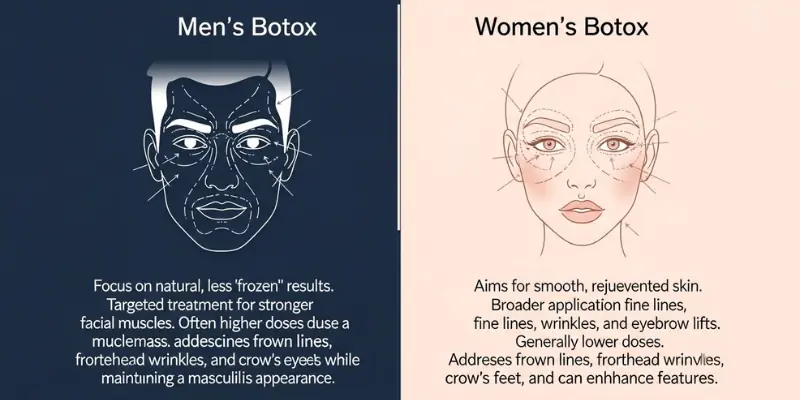
This is one of the most important sections for men to understand — because poorly calibrated Botox that feminises male facial features is one of the most common reasons men are reluctant to seek treatment, and one of the most avoidable outcomes with an experienced clinical injector.
Different Muscle Mass and Structure

Men typically have significantly stronger and larger facial muscles than women — particularly the frontalis (forehead), corrugator (between the brows), and orbicularis oculi (around the eyes). Stronger muscles require higher doses to achieve the same degree of relaxation. Under-dosing in male patients produces inadequate results because the muscle overpowers an insufficient dose. This is one of the key technical differences between treating men and women.
Different Aesthetic Goals
Male facial aesthetics prioritise natural, rested, and defined rather than the smooth, lifted result more commonly sought by female patients. Men generally want to look like a well-rested, healthy version of themselves — not to look like they have had a treatment. The goal is a refreshed appearance, not a frozen one.
Specifically, the male brow sits lower and flatter than the female brow — which is typically positioned slightly higher with a natural arch. Overcorrecting a male brow upward or creating an arch where none exists creates a feminised appearance that most male patients find worse than the original lines. At Vitalis Luxe Clinic, preserving natural male brow position and movement is a technical priority in every male treatment.
Movement vs. Immobility

A completely immobile forehead or face reads as artificial in most social contexts — and this is something most male patients explicitly do not want. Male Botox at Vitalis Luxe Clinic is calibrated to reduce the most pronounced lines and expressions while preserving natural, appropriate movement. The aim is to look like you have had a good night’s sleep — not like you cannot move your face.
The Most Common Treatment Areas for Men
1. Forehead Lines
Horizontal lines across the forehead created by raising the brows — often the primary concern for men seeking anti-wrinkle treatment. These lines can become deeply etched with age and repeated expression, giving a worried, tired, or aged appearance even when relaxed. Botox relaxes the frontalis muscle responsible, smoothing the lines.
Important technical note: the forehead cannot be treated in isolation without considering the brow position. The frontalis also holds the brow up — treating it too aggressively without accounting for this lifts or drops the brow in unintended ways. At Vitalis Luxe Clinic, forehead treatment is always assessed in the context of the whole upper face.
2. Glabellar Lines (‘Eleven Lines’ / Frown Lines)
The vertical lines between the brows created by the corrugator and procerus muscles — often described as the ’11s’ — are among the most ageing and emotionally misrepresentative features a face can develop. Men with prominent glabellar lines frequently report being told they look angry or unapproachable when they feel neither. Relaxing these muscles produces one of the most striking and universally appreciated results in male facial aesthetics.
The corrugator muscles are typically very strong in men, requiring robust dosing to achieve adequate relaxation. Under-treatment of this area is a common reason men are dissatisfied with Botox from inexperienced injectors.
3. Crow’s Feet
The radiating lines at the outer corners of the eyes produced by the orbicularis oculi muscle during smiling and squinting. In men, crow’s feet can add significant apparent age. Botox in this area softens the lines while preserving the natural eye crinkle during genuine smiling — which should remain.
4. Bunny Lines
The diagonal lines on either side of the nose bridge created by the nasalis muscle when wrinkling the nose. Often become more visible after glabellar treatment as men who previously used the glabella to express frowning shift expression to the nose. Easily treated with small additional doses.
5. Brow Lifting
A small, precisely placed dose above the lateral (outer) portion of the brow can produce a subtle lifting effect, opening the eye and reducing the heavy, hooded appearance that develops in many men with age. This is a nuanced technique — the lift must be modest and natural rather than the arched feminine result, which requires careful positioning and dosing.
6. Hyperhidrosis (Excessive Sweating)
Botulinum toxin injected into the axillae (underarms), palms, or soles blocks the acetylcholine signals to eccrine sweat glands, dramatically reducing sweating in the treated areas for 6–12 months. This is one of the most life-changing applications of Botox for men with hyperhidrosis — a condition that significantly affects professional and social confidence and is almost never addressed through standard NHS pathways. Results typically last significantly longer than facial Botox.
7. Masseter Reduction (Jaw Slimming)
Injection of botulinum toxin into the masseter muscles — the large jaw muscles used in chewing — relaxes and gradually atrophies them over 4–6 weeks, reducing the apparent width of the lower face. In men who grind their teeth (bruxism) or clench their jaw, this also provides significant relief from jaw pain, headache, and dental wear. Results last 4–6 months and often extend with repeated treatment as the muscle volume reduces cumulatively.
Treatment Area | Target Muscle(s) | Typical Result | Duration | Notes for Men |
|---|---|---|---|---|
Forehead lines | Frontalis | Smoothed horizontal lines; relaxed brow | 3–4 months | Must be calibrated with brow position; higher doses than women typically needed |
Glabellar lines (11s) | Corrugator + Procerus | Reduced angry/frowning appearance; softened between-brow lines | 3–4 months | Strongest muscles in face; robust dosing critical; very high patient satisfaction area |
Crow’s feet | Orbicularis oculi | Reduced radiating eye lines; more rested eye appearance | 3–4 months | Preserve natural eye crinkle during smiling — natural movement maintained |
Brow lift (lateral) | Orbicularis oculi (lateral) | Subtle brow elevation; opened eye appearance | 3–4 months | Must maintain flat male brow shape; not arched |
Bunny lines | Nasalis | Reduced nose-bridge lines | 3–4 months | Often treated alongside glabella |
Hyperhidrosis (underarms) | Eccrine sweat glands | 80–90% reduction in sweating in treated area | 6–12 months | Life-changing for sufferers; longer-lasting than facial Botox |
Masseter (jaw) | Masseter | Slimmed lower face; bruxism relief; jaw pain reduction | 4–6 months | Cumulative volume reduction with repeated treatment; also helps teeth grinding |
What to Expect: Before, During and After Treatment
Before Your Appointment
- No alcohol for 24 hours before treatment — alcohol thins the blood and increases bruising risk
- Avoid aspirin or ibuprofen for 48 hours if possible (and not medically contraindicated) — these also increase bruising risk
- Come with a clean face — no heavy moisturiser, sunscreen, or skincare at the treatment site
- Arrive ready for a brief clinical consultation — your clinician will assess your anatomy, discuss your goals, and agree a treatment plan before any injections are administered
During the Treatment
Botox injections for the full upper face typically take 15–20 minutes. The needles used are very fine — most patients describe the sensation as a mild pinch. No anaesthesia is required. You will be seated upright and asked to make specific expressions to identify muscle positions. The number of injections varies by area and individual anatomy — typically 10–20 injection points for a standard upper face treatment.
After Treatment — What to Do and Not Do
- Remain upright for at least 4 hours post-treatment — do not lie flat
- Do not rub or massage the treated areas for 24 hours — this can cause product migration
- Avoid intense exercise and excessive heat (saunas, hot showers) for 24 hours
- Mild redness, swelling, or small bumps at injection sites are normal and resolve within a few hours
- Bruising is possible — more common in some individuals; typically resolves within 5–7 days
- Results begin to appear at 3–5 days; full effect at 10–14 days
- A review appointment at 2 weeks allows assessment and any top-up if needed
How Long Does Botox Last for Men?
For most men, Botox lasts 3–4 months. Because male facial muscles are typically stronger than female, the duration may be slightly shorter in men — particularly in the early treatments before the muscle-weakening effect has had time to reduce overall muscle bulk with repeated treatment. Men who exercise heavily and have very high metabolic rates may also metabolise botulinum toxin more rapidly.
With regular treatment — typically 3 times per year — many men find that their results last progressively longer as treated muscles reduce in bulk and the lines they create become shallower and less established. Preventive treatment begun before lines are deeply etched produces better long-term outcomes than treating already-established lines.
Frequently Asked Questions
Is Botox safe for men?
Yes — botulinum toxin has an extensive safety record in both medical and aesthetic applications spanning decades. When administered by a trained clinician in appropriate doses to correctly identified muscles, its safety profile is well-established. The risks at clinical doses are minimal: temporary bruising, localised swelling, and in rare cases temporary weakness of an adjacent muscle that resolves completely as the treatment wears off. At Vitalis Luxe Clinic in Hull, all Botox is administered by trained clinicians.
Will I look frozen or unnatural?
Only if the treatment is overdone or poorly calibrated — which should not happen at a clinically led practice. The goal of male Botox at Vitalis Luxe Clinic is a natural, rested appearance that preserves appropriate movement. Men should be able to raise their brows, show emotion, and smile naturally. A good result is one that others cannot identify as a treatment — they simply notice that you look well.
Does Botox hurt?
Most patients describe the injections as a mild pinch — brief and well-tolerated. The needles used are extremely fine, and the injection volumes are small. Numbing cream is available for particularly sensitive areas (such as lip or forehead) on request, but most men find it unnecessary. The entire upper face treatment takes 15–20 minutes from first to last injection.
How much does men’s Botox cost in Hull?
At Vitalis Luxe Clinic, male Botox pricing reflects the typically higher doses required to achieve results in stronger male muscles. We price per area treated or by total units used — your clinician will provide a transparent quote at your consultation before any treatment is agreed. We do not use hidden charges or pressure tactics. Contact us or book a consultation to discuss current pricing for your specific areas of interest.
Will people know I’ve had Botox?
If done well — no. The consistent feedback from men treated at Vitalis Luxe Clinic is that friends, colleagues, and partners notice they look well or refreshed, without being able to identify a specific treatment. This is the intended result. Obvious, frozen, or feminised results are avoidable outcomes of poor technique or inappropriate dosing — not inevitable consequences of Botox treatment.
Can I combine Botox with TRT at Vitalis Luxe Clinic?
Yes — many men at Vitalis Luxe Clinic in Hull access both TRT and aesthetic treatments as part of a comprehensive approach to looking and feeling their best. The two treatments are entirely compatible. Some men find that the energy and wellbeing improvements from TRT increase their interest in their overall presentation, making aesthetic treatments a natural complement. Our Hull clinic provides both services under one roof, making combined care straightforward.
How often do I need Botox to maintain results?
Most men maintain results with treatment every 3–4 months — approximately three times per year. With regular treatment over time, many men find they can extend the interval between appointments as the treated muscles reduce in activity and the lines they create become less pronounced. Stopping treatment entirely returns the face to its natural state over several months; the effect is temporary and reversible.
Where can I get men’s Botox in Hull or Yorkshire?
Vitalis Luxe Clinic in Hull provides clinician-led Botox treatments for men across Hull, East Yorkshire, and throughout Yorkshire. Our experience in male facial aesthetics means we calibrate treatment to male anatomy, dosing requirements, and natural-looking outcomes — not a one-size-fits-all protocol. Book your confidential consultation today.
Looking Your Best Is Not a Female Concern
Male aesthetics is one of the fastest-growing sectors in UK healthcare — and for good reason. Men have the same interest in looking well, presenting professionally, and ageing on their own terms as anyone else. There is nothing remarkable about that. At Vitalis Luxe Clinic in Hull, we provide Botox for men with the clinical expertise, honest communication, and discretion that male patients deserve. Whether you are considering treatment for the first time or looking for a clinician who understands male facial aesthetics, we are here. Book your confidential consultation today. We serve men across Hull, East Yorkshire, and throughout Yorkshire. |